Sunday, 7 September 2014

More On Less Money


This post is a steal from The Automatic Earth rather than a link.  At 1560 words it is an interesting take about the changed world and radically altered money systems.

Last week's Money and Markets had an extended article by Martin Weiss on Black Swan event major worries.  He says that a number of nesting Black Swans are ready to fly.

Quote:

Looking around us today, it would – or at least could – seem obvious that we live in a new world. Which we don’t recognize – as being new – because we don’t want that world. We instead want more of what we used to know, with icing and a cherry on top.

 We want to go back, not forward, though we don’t phrase or see it that way. The underlying issue is that the ‘forward’ we do want is not available, and we have no problem fooling ourselves into believing we can still achieve it.

We want a world controlled by America, with Europe as a sort of hunchbacked sibling obediently limping in its footsteps. That is familiar, and that feels safe. Like it was in days gone by, went things seemed to go well for us. We want what we had back then, we just want more of it. We want growing economies, and better lives for our kids than we had, just like our parents did.

When there’s a crisis, we want it solved, so we can return to what we had, and add to it.  Because we so obviously and one-dimensionally want this and only this, it’s very easy for those who try, to make us do whatever it is they like, as long as they hold forth the promise of delivering our ideal world of more of the same and then some.

There’s no-one who promises a world of less, or a world that is genuinely new, not just in name, who stands a chance of being taken serious, much less of being voted into office.

There’s not an economist who doesn’t promise a return to growth, or to prosperity, if only some model (s)he believes in is followed. More stimulus, less stimulus, the ideas and theories and models seem to run the gamut, but actually they’re all the same.

They’re goal-seeked. Economics as a whole, as a field, is. There are no theories that seek not to return us to growth. As if eternal growth is a natural law or a god given right.

We are already paying a huge price for having these contorted and convoluted images presented and sold to us as real, and for us to buy into them. In Japan, Shinzo Abe is busy unleashing an economic Fukushima upon his people, just so their country can return to growth.

In China, the amounts of credit with which markets are flooded just so the illusion of growth can be maintained are stupendous.
Europe can’t wait for its crisis to be finally over, so more of the same, plus a bunch of added gadgets, is there for everyone to grab onto. In the US, the media-induced consensus is that the return to growth has already been realized.

Hail the central bankers. More of the same, in various stages of ‘development’, can be seen in many other countries across the globe. All geared towards additional growth, towards hopes and dreams.

But everywhere, save perhaps in a few very poor places, the illusion of growth can only be bought with debt. And debt, how ironic, is the opposite of growth once there is too much of it. So they just have us believe there’s no such thing as too much.

A report from two St. Louis Fed economists this week blames low inflation levels in the US on ‘consumers’ hoarding money. With 40+ million Americans on food stamps, they could think of nothing else than a local version of Ben Bernanke’s insane notion of ‘excessive savings’ in China holding back the world economy.

Without even considering the option that people simply don’t have money to hoard. That they instead are buried in debt. That the money pumped into the system only reaches the top part of it, and gets stuck there. If people don’t spend, it must be because they have tons of cash sitting in their mattresses, not that they don’t have it.

A sadder picture of the state of economics could not be painted. What even more sad is that these are the kind of yokels who determine economic policy.

We don’t stand a chance. At first, I liked to see them address velocity of money in their inflation ideas, but then found they had no idea what it was or meant. US velocity of – base- money is at a record low.

 People are not spending. The same goes for Japan and Europe. But that’s not because people are wallowing in endless piles of cash. It’s because they’re at the end of the line.

A somewhat related piece has PIMCO bond manager Bill Gross explain how it all works according to the book he talks:

Two variables figure in the monetary straitjacket Gross describes: credit creation and credit velocity. The former must constantly expand at a high enough rate to pay interest on previously issued liabilities so as not to trigger the need for the sale of existing assets. If the current rate on outstanding debt in the U.S. is 4.5%, the Fed should target credit expansion of at least 4.5% per year.

Nevertheless, credit expansion has averaged just 2% for the past 5 years and only 3.5% in the past year. U.S. underachievement in credit creation is to blame for today’s economic stagnation, where the economy struggles to reach 2% real GDP growth.

A second variable of monetary policy is the velocity of money. Gross says no central banker knows how fast money should be changing hands in the economy and must therefore only dial the level up or down cautiously in order to avert a credit collapse.

But as a general rule, he writes, “the projected return on financial assets (relative to their risk) must be sufficiently higher than the return on today’s or forward curve levels of cash (overnight repo), otherwise holders of assets sell longer-term maturities and hold dollar bills in a mattress — lowering velocity and creating a recession/debt delevering.”

Now you know: The US doesn’t create enough additional debt. That’s why the economy is doing so poorly. Where is other times the economy was founded and built on production, on people working and producing things, it’s now debt that makes it tick.

And since people don’t have money, contrary to what the St. Louis Fed guys claim, they will need to borrow, says Gross. But they don’t. Not even at historically low rates. And if people don’t have money, and don’t borrow, they don’t spend, and you’re not going to get either growth or inflation.

By the way, why inflation at certain levels has achieved such a mantra-like status is beyond me, certainly in the way it’s supposed to be manipulated by central bankers. I always thought a central bank’s main task was to make sure just enough ‘money’ was in circulation in an economy to let it function. Not to set a goal for inflation levels.

Which undoubtedly is why they predictably always fail to achieve whatever goal it is they set. Of course, as per Bill Gross just now, central bankers must tamper in a similar way with the velocity of money (consumer spending) and ‘dial the level up or down cautiously’.

As if Bernanke can make Americans spend more, or less, as and when he sees fit. How crazy do ideas get? Is that mere wishful thinking, is it goal seeking, or is it an elementary lack of intelligence?

It’ll take us forever and a day to pay down our debts and achieve some, any, kind of growth again. But that should not be the end of the world, it’s merely a transition to a new world, which has already dawned (just not on us).

We’re in a new world, one without – economic -growth, but we see it through old eyes, and it’s ruled through old politics. If we don’t recognize the dangers of that discrepancy in time, we’re going to enter an era – we may already have – of many more botched western interventions like the ones in Ukraine and Iraq.

Where our leaders, who always were power hungry to begin with, turn out to be blood thirsty as well, when it comes to re-establishing the power structures of old, which belong in times gone by, and which will never come back.

The task of – central – governments, central bankers, and certainly alliances like NATO, should be to make sure as few people get hurt in this transition as possible. They should be the keepers of the peace, and the protectors of the weak as well as the natural environment in their part of the world. So far, they’re 180º off in every single respect.

As long as we insist on seeing the world through our old eyes, focused on growth and on more of whatever we feel we need even more of, we will continue to pick the leaders who promise us that. That may have been sort of fine 50 years ago, but in today’s world it can only lead to destruction, bloodshed, poverty and misery.

We’ve seen our world change, and we’ve failed to keep to up with the changes. We don’t want to be content with less, no matter how much we already have.

What we possess has become our self-image, and the one we portray upon the world. But be careful: it we don’t change that, fast, it’ll lead us to places we don’t want to go.

Unquote.

Just a rider, GDP statistics should be filed under fiction.

Saturday, 6 September 2014

If You Want To Know The Time


Meanwhile at Wuppertal in Germany, the Sharia Police from the local migrant community have been attempting to prevent the late night booze and bonk culture only to be arrested by the regular police.

It makes me yearn for a force of Sharia persuaders here at weekends when our County police in the name of commerce and modern culture let it all hang out.

But will in New Scotland the SNP, with its centralised police and local government systems as well as open borders welcome the intervention of similar Sharia law enforcers on the streets of Glasgow and Greenock?

Or will they oppose and stop an attempt to ensure sobriety and decency on the streets on Saturday nights at levels that the most strict of Presbyterian ministers would approve?

With the debate now locked in to who offers the biggest and best benefits, who will leave more money in your pocket to spend on essential cultural purposes, such as betting on Sky TV and who will ensure that nobody will ever go short or earn or be given less than the average income?

According to "Private eye" this week, the Russians have taken a major role in Norway's North Atlantic Drilling.  Doubtless the Russian navy will be anxious to protect their investments and police the relevant waters in the absence of any other navies.  Matters like this are off the agenda.

Relating to the Sharia question above, the immigration question is one that has been avoided at all costs.  But the single Scots UKIP man has suddenly decided to have a go.  In a noisy intervention in the quiet and limited debate, he claims that open borders means that Scotland will be not for the Scots but in time, perhaps a short one, will be for others.

So when the SNP refer to a closer attachment to Scandinavian nations it may not be the shared Viking heritage, or the return of the fishing industry or such but more the proportion of recent migrants in the capital cities of Copenhagen, Oslo and Stockholm.

Little is known about these demographic changes because the view is that this is not something to be discussed and any difficulties are purely temporary and can be dealt with by more public spending and conceding legal authority to the incomers.

These are long term matters on the whole, so there is no need to worry.  But there are some short term ones again absent from discussion.  One is the period of transition and the costs attached to it.  The various attempts at this seem to be making it up as you go along.

The SNP use the back of a small envelope, but the Unionists prefer the larger one.  As a veteran of reorganisations of the past as well as having interests in complexity and uncertainty, again predictions are very risky.

In general though what happens is usually worse than expected because of known human frailties and the impossibility of knowing the future in detail.

My view is that the big one is missing.  This, yes an obsession, is the heavy costs and difficulties of dealing with all the relevant computer and software issues and requirements and the staffing implications.

Not just Westminster but many others have made huge expensive mistakes and have been taken for a ride.  Too many have fallen off in the process.

In the case of the government in the UK the consequences have been major failures in services and systems, SNATS writ large; situation normal all total shambles.

If so then not even the Sharia police could sort it out.

Friday, 5 September 2014

Carbon Copy


The debate on global warming, cooling, where, what and how is one that is difficult and excites strong differences of beliefs and feelings.

History tells us that climate, weather and a lot else will change but which way the ancient gods of time will jump is always a guessing game.  They are willful, deceitful and unreliable.

This link tells you why from Euan Mearns blog and is by Roger Andrews .  He is expert and those commenting are expert.  Make of the piece and comments what you will.

What was learned is that if people like this find it complicated and open to debate why are our politicians and government departments so certain?

If it was just a minor issue of incidental interest compared to grand policy and major decisions on the flows of state spending and organisation of the economy, it would be one thing.

But it is cited as being the critical factor in decision making about all our futures, economic and personal.

Thursday, 4 September 2014

Shopping Blues


Apparently there is now so much fiddling the food by makers and retailers and the rest that a lot of what we might buy is not what we think it is or ought to be.

Inevitably, the government has declared war on "food crime" and threatens those responsible with the full power of the state and dire consequences.

In the meantime those who have been burgled or battered are being invited to conduct their own crime investigations.  If this allowed me to be judge, jury and wielder of a cat o' nine tails it might be worth it.

There is nothing new in food adulteration or the like as the poem says in the link, "The Song Against Grocers" by GK Chesterton.   It has just moved on, become more rampant, and now has the full weight of modern marketing behind it as well as the power of science.

Of course, the old fashioned grocers are all long gone.  Now we are lucky enough to have the supermarkets.

Wednesday, 3 September 2014

Eating People Is Wrong


Two stories running in parallel at the moment are about the quality of hospital food available and prescribing medication that adversely affects people with known allergies.

Hospital catering is mass catering.  But the "customers" do not go there to eat.  The eating is to enable them to survive and a vital part of the recovery or treatment process. The caterers, whether in house or out sourced have to deal with an ever and rapidly changing group of people.

There are some real problems here.  One is that food which is "healthy" may not be the food that many like.  But the food that the mass of people like may be bad for those who really do need "healthy" food.  This is before we begin to think about matters relating to ethnic or religious requirements.

Medications are not simple matters.  The trouble with this BBC story about allergy effects is that it may not be the substance critical to need that is the problem but one of the several or many packed into the pill or capsule or fluid to enable it to be taken easily and without taste issues.

One case known is a person who went into hospital but whose records were fully available.  This one was unlucky in having strong reactions to both gluten (wheat and some grains) and lactose (milk and dairy).  They soon developed bad digestive problems.

The dieticians supplying the food did their best but had very little food or options available to deal with this.  So there was a very limited diet of small portions.  But the digestive problems worsened and by discharge both food and liquid could not be taken.

On arrival home with the package of hospital medications then it was realised that two of the four clearly had lactose content.  Stopping them gave recovery within hours, although it then took days to obtain non-allergic substitutes, the problem being that they were not on the approved list for budgetary reasons.

Where the problem lay among the very busy, expert and good staff at the hospital was that although some knew of the issue the pharmacist did not since it was not the job of any to tell the pharmacist and the doctors did not take account of allergy.

Which raises the question of all those people apparently suffering serious dehydration or lack of food and who are in real trouble, some dying.  The management systems of the present completely lack the flexibility or the scope for individual inputs where reactions or allergy might be involved.

There is the ancillary problem that many who are reacting to gluten or lactose with digestive issues do not know that they are vulnerable because the family doctors have neither the time nor the brief to attempt any analysis into possible dietary complexities.

They just prescribe a pill or antibiotic that may make matters worse.

Tuesday, 2 September 2014

All Change On The Money Go Round


On the whole linking and reading items that are succinct, not too technical and which can be more or less explained correctly to others is preferred.  But some material out there is challenging, especially about economics and money.

At Lindau in Bavaria, still in Germany, there has been a grand assembly of economists to discuss the their sciences, which some argue is not science.  Frances Coppola was there and is commenting on items for Forbes.

This article on monetary liquidity in "Forbes" is not easy and has inherent difficulties despite her effort to keep it clear.  It says that in the last few years there has been a major change in money creation and how liquid it has become.  The obvious problems for monetary policy are suggested.

In my view simply rewriting previous economic theory is not enough and governments and central banks are faced with key changes that impact on policy and control.

Because of new technology, structures, rapid communication and action, new financial products and crucial changes in how money and finance work and changed forms of money; it is not just a matter of technicalities and organisation but is far more radical in its effects.

It brings to mind the early 19th Century when horse drawn transport and sail were supplanted by steam and then oil and in financial terms later when bullion and free markets gave way to fiat currency and the state.

It could be that we have entered a new monetary world and this is going to change everything.

One thing will be the ability of governments to govern.

Monday, 1 September 2014

1320 The Declaration Of Arbroath Part Seven And Last


Clauses Five and Six
Theories of Kingship

A great deal of ink has been spilt on the matter of how different elite’s dealt with the question of Kingship.  Whatever the theory, the historical practice suggests that it would have been more honoured in the breach than the observance.

Many of the Tsars and Tsarinas of Russia considered themselves to be elected, although the circumstances of many of the acquisitions of the throne are open to all sorts of questions.  The feudal Kingship of England does not have a history of seamless transition by right of descent.

The wise noble, knight, or leading churchman in 1320 would have made their bets each way.  One of the interesting aspects of the Declaration is the names that are missing from the roll.  Taking these together with a proportion of trimmers from the signatories does not alter the majority support for King Robert de Brus but is only an admission of the realities rather than the romance of politics.

Within the Declaration divine providence in the succession of Robert is praised and then is balanced with the bald threat of his displacement if he rats on the deal.  Who were the men that wanted such a statement built into the document?

It is an opinion, but my instinct would point to the men of the far north who had not forgotten their Norse and Viking links and connections.  Thane Thorfinn Skullsplitter was gone but not forgotten.

It is suggested that the theory of election is owed to a particular device of the ancient world, that of the tanistry employed by the earliest known chiefs.  The theory of election, however, applied just as much in many parts of Europe in the period.  Not only was the Pope elected, many principalities had Electors, and other arrangements were common.

The difficulty is the absolute requirement at the time for any statement of rights and procedures to be given credence by the claim of ancient history, learning, or that most elastic of commodities, custom.  This was so until the 18th Century when the push for pure reason and empiricism began to make headway.

But a great deal of political philosophy referred to ancient times, although the truth was unknown and a matter of guesswork and myth.  The Divines were obliged in their disputations to refer to the ancient fathers of their Churches, and even the 19th Century Temperance Movement was wracked by the debate over the Biblical evidence about the alcohol content of wine.

It was fortunate that the history of man has been such a varied and confused business that a precedent may be found for almost anything that is expedient at the moment.

So what exactly does “libertatem” mean in the context of the Declaration and its time?  It does not presage 18th Century enlightenment ideas about freedom and the Rights of Man, it is about the ability of the nobles to run their own affairs as they wish.

It is a theory of devolved absolutism that took time to dislodge.  Even into the 18th Century Scots coal miners under the Stuarts and their successor Hanoverians were employed on a basis of family contract that amounted to quasi-slavery for them and their families.

Clause Seven
Little Scotland And Making England Little

Essentially, stripped of the verbiage, this clause asks for the King of England and therefore his realm to be excommunicated.  Also, the Declaration flags the breakup of the Kingdom of England on the grounds that this would enable the Scots to live in peace.

Most probably, it is a bid for the Scots to take over the ancient Kingdom of Northumbria.  The action instigated by the Kings’ Edward was to protect their interests in the North of England and to curb the persistent Scots raiding by asserting an overlordship and control, in short, dog eat dog.

The Declaration refers to the Pope as the Vice Regent of God on earth, accepting Pope John’s own perception of the relationship between the Church and State.  This alone indicates the great influence wielded by the Church in Scotland.  The western mind today has difficulties in comprehending the nature of Islam and the meshing of religion and politics in its affairs, and, note, I put religion first.

So do modern generations have difficulty understanding the Medieval World and its constructs of mind.  Because for us politics is all we seriously underestimate the weight that the great churchmen of the time brought to bear on the secular elites.  In Britain, the Dissolution of the Monasteries meant the end of a Church, and the scattering of libraries.

Critically, it entailed the loss of the archives and consequently an understanding of the reality of the politics of the earlier age.  We can only be dimly aware of where the real balance of power lay and the age in which we live assumes secularity because of our own preoccupations.

Clauses Eight to Twelve
Oh Ye Of Little Faith

At this stage the voice of the Churches and the religious of Scotland is in full flow.  Quite whether all the Scots signatories would have sold their estates and marched off to the Holy Land to do their Christian Duty if the Pope had dished the King of England and broken up his realm is an interesting question.

I have doubts, and a suspicion, which is ignoble and cynical, crosses my mind that the Churchmen would have been the ones to benefit in that they would have been able to augment their growing possessions.

All this is wholly consistent with the Papal, and Dominican, world view.  One of the potent symbols of the Papacy is the Keys, those that gave admission to the Kingdom of Christ the All Powerful and Knowing.

Similarly the Province of York, the Archbishopric, also uses the Cross Keys as its heraldic device.  The Princes of the Church were the gatekeepers to the Gates of God, and the Kings and Princes of the Earth were subordinate in matters of belief, morals, ethics, laws and learning.

The remaining clauses are a Friar Preacher’s reiteration of the basis of the Declaration as a text about authority, submission, and overlordship.  The “libertas” is about the freedom of a few to be local autocrats and not remotely to do with any ideal of personal freedom and rights for all men, or women.

The “Liberties” in that age were defined areas and peculiars with separate arrangements, very often allotted to the Church, as a patch of ground free from the general law applicable in the vicinity.

WHAT IS THE DECLARATION?

Clearly it is a submission to the Pope, those are the rules of engagement.  As a submission to the Pope for his guidance, support, and authority it has to be to be on the basis of his vision of Christendom and his political philosophy and perceptions of power.  If that is the case it is not a Declaration of Independence, it is an homage, in the full sense of the understanding of the period.

In essence the Scots Church and magnates were asking for “poor little Scotland” to be a papal State, albeit under the indirect rule of the acknowledged King as the subordinate agent of the Pope, to act as the hereditary Guardians of the Holy Places of early Christianity in the Atlantic Archipelago.  The submission is wholly consistent with the Thomist theology of the Dominican order, and refers back to the thinking on the structure of Heaven and Earth as set down by St.Augustine, one of the major influences on the Benedictines.

Even in the 14th Century, a document of this importance would not have been created simply by the local Abbot writing a document at the behest of his King, them then calling in the rest of the team to sign it and then sending it off, hoping for a favourable reply by return of post; preferably with a cheque.

If in the hands of the Religious, especially the Dominicans, the genesis would have been a more complicated matter, not to say tortuous.  I would expect that the origins of the document would have been some months previously.

What event or circumstance in 1318-1319 may have triggered the accession to the Pope about the status of Scotland?  From the Scottish side the breakdown in negotiations with England in 1318 and the sheer confusion in England would have been enough, let alone the other imperatives facing them.

My personal judgement is that the Declaration shows the hallmarks of a document that has been cleared with whoever is due to receive it before it is put in place.  In short it is not a simple submission to the Pope, but the Pope and the Curia at least would have been aware of what was happening and so the Declaration had to fit their own particular vision of the needs of the time.

The Pope had not long beaten off the claim of the ambitious King Louis of Bavaria, aspirant to the title of King of Germany, and the richest monarch in Europe, to determine who should appoint the Imperial Vicar of Italy.  The successful assertion of the City of God over the City of Earth in the matter of worldly jurisdictions would have been enough to persuade the King of Scots and most of his nobles to sign the Declaration.

Structurally the Declaration is interesting and in many respects is a sermon from the mind of Friars Preacher.  It is in the form of a Dialogue with the questions absent, but implicit in the layout and thrust of the text.  For most of the passages, the hand of the Dominicans can be detected, although clearly there are additions and embellishments.

As men of the religious orders occupied almost all the senior administrative positions in the Courts of Kings and Princes it is expected that their mark will lie on most documents.  But the Declaration is clearly not a legal plea over points of law; it is a supplication to God, for His Blessing and Mercy, through the agency of his Vicar and Vice Regent on Earth.

It is understandable that the Scots magnates and landowners would be wary of any English system, with self-governing boroughs, Parish administration, and the common law.  Equally, if the intention of the Kings of England, in contrast, was to impose direct rule through appointed Sheriffs and Bailiffs, that would be less welcome.

The feudal law and the King’s courts would seriously limit and impede their local powers.  Certainly there would be a substantial risk of a King of England wanting to adopt the practice of the dispersion of holdings, used elsewhere, as policy to reduce the large coherent territories of the Scots nobility.

They would see this as an emasculation of their power and authority.  They wished to retain the personal absolutism and administration of law in their districts; that is to continue as local autocratic war lords instead of becoming managers of property and incomes under an obligation to bear arms for the King.

Given all the factors involved the Declaration is a document of its time, if not of its place, that being the context of the major centres of power in continental Europe.  Essentially, it is about religious as much as temporal power in the uncertain world of the early 14th Century.

The Ascendancy Of The Northmen and their Norman cousins in Scotland wanted a clear break from those of England, and the opportunity had arisen for it to be done for sound reasons for both the religious and secular power groups in Scotland.
Contemporary commerce and finance played its part, although not a great deal is known about the complex of Scotland’s trading at the time.

It is unlikely that the Scots would have seen themselves benefiting from coming under the sway of the rising dominance of the polyglot London of the early 14th Century that already had most of England in its commercial grasp.

Even allowing for the economics, which King ruled and how, then it was still largely a matter of faith and the Will Of God, that most changeable of minds.

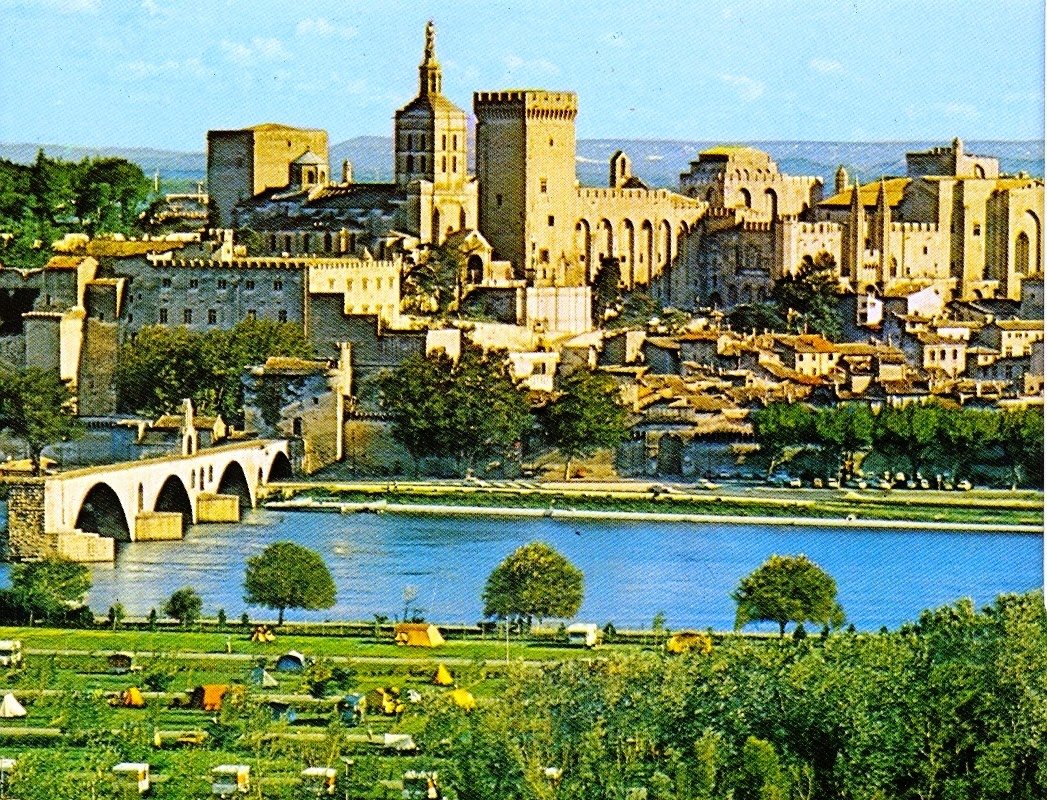
The picture above is the Papal Palace at Avignon across the river from the camp site we visited so many times on our travels.  It was a cross roads of Europe at the time.