Wednesday, 15 August 2012

Thought For The Day First


Sinbad Boris Johnson, the brood Mayor of London was fervent in support of his local bankers, Standard Chartered, who have forked out a third of a billion in fines for being shifty with the accounts.

His recent elevation to the Zip Wire brought to mind one song from another age, two minutes long.


They should have left him there.

Tuesday, 14 August 2012

Another Day Another Complication


Taken from “The Local”, Germany’s news in English, it seems that distaste for the EU and the current nation states embroiled in it is not just a UK matter.  There are those in Bavaria who now argue that Bavarian Is Best.

Skipping all the obvious stuff about the strange King Ludwig II and Richard Wagner, the composer, it has taken some time for leading Bavarians to come round to the idea that they are better off out than in, and that means Germany as well as the EU. 

This one could run and run.

Quote:

A respected old-timer in the conservative Bavaria-based Christian Social Union (CSU) has called for independence for his beloved state, arguing that its wealth is being fleeced by Berlin and Brussels.

The 73-year-old Wilfried Scharnagl, a well-known name within the CSU - the sister-party to Angela Merkel's Christian Democratic Union - is to publish a book this week entitled "Bavaria Can Go It Alone," the Münchner Merkur reported on Sunday.

"Bavaria," he told the paper, "comes out too badly in context."

That context, laid out in his 191-page tome, is an historical analysis going back to 1871, when Bavaria became part of the new unified German nation. That day, "The Day of Disaster," as Scharnagl calls it in a chapter heading, was when "the kingdom was absorbed into the Prussian-ruled German unified state."

As a result of that fateful move, Bavaria is now in a "stranglehold", held in "double oppression" by Berlin and Brussels, the Bavarian veteran said.

He describes some of Germany's budget arrangements, such as the inter-state fiscal adjustment which distributes tax money among Germany's 16 states, as a "plundering" that consumes billions in Bavarian wealth, while the euro debt crisis reinforces the "lurching between fantasies of power and powerlessness."

He argues that federal measures to balance conditions in Germany have always damaged standards in Bavaria, such as the level of education, which he calls Bavaria's "crown jewel." "I've never known levels to be adjusted upwards," he said.

Scharnagl worked for the CSU's party leadership in Bavaria for many years, and was editor-in-chief of the party's newspaper Bayernkurier for 24 years. He was also considered a close personal advisor to Franz Josef Strauß, former German finance minister and Bavarian state premier from 1978 to 1988.

Scharnagl's word is still said to carry weight within the party, though the new book is likely to alienate some of his political allies. Only the minority separatist Bayernpartei officially supports independence. His own party briefly toyed with the practicalities of independence under state premier Max Streibl in the early 1990s.

Scharnagl considers his book an important provocation. "It is at least a wake-up call, to say that this state should consider its peculiarities, its uniqueness," he told the paper.

Unquote

Next up the Duchies of Bremen and Verden, perhaps?  For a long while in the 18th Century and into the 19th these were attached to Great Britain.  If the UK could exit the EU perhaps they would like to rejoin us, along with Hannover.

We could have “The Old Hundredth” as a new National Anthem.


Monday, 13 August 2012

What Happened Next?


Retrospectives are fun, if you like that sort of thing.  For those that go back before people were born they can be fun, unless they really missed something.  For those that return people to memories of the past they may or may not be fun depending on their situation was.

In 1948, according to the newsreels and media of the time, we had an Olympics party and were told to be proud of it all.  Great Britain was still great and a force in the world and could put on a good show.  All was for the best in the best of all possible worlds, this one a Socialist one.  So then what happened?

In China the end game was in play for the American supported Chiang Kai-shek regime and it was not long before Mao and the Communist forces entered Beijing and went on to capture Shanghai.  They established a new regime and radical changes in both economic and social policy.

The USA saw the re-election of Harry Truman to the Presidency beating both his fancied Republican opponent, Dewey, and the bookies.  The main media had Harry marked down as a loser and were wrong.  This meant he was now able to assert himself and the USA as an active world power.

Russia tested its first atomic bomb, much to the surprise of the USA and the UK.  The question was how.  The UK which had happily given away free of charge much of its scientific advances to the USA discovered that some had felt the same should go to the USSR.  The result was a blitz on security, paranoia ruled OK.

The realisation that the air threat from the USSR was not just large fleets of bombers but now nuclear forced a large scale revision of strategy and military organisation amongst the western allies.  The UK was especially at threat and not just the American bases.

North Korea declared itself to be a communist Republic and the new leader; Kim Il Sung was committed to the reunification of Korea as a communist state and an enemy of foreign capitalism.  War was not long in coming and it was a nasty bitter one that embroiled the USA, the UK, the Australians and others.

Germany saw the divisions of the occupation enforced by political changes.  In the West, elections were held in a new Federal Republic with Konrad Adenauer becoming Chancellor.  He has a vision of a new Europe, united economically and politically and committed to peace.  The Soviet Union, in retaliation set up the East German state.

India declared itself a Republic and the Congress Party used military force in the name of democracy to defeat the Nizam of Hyderabad’s wish to remain a principality.  Ireland also declared itself to be a Republic.

The transistor was revealed to the world which set in train a radical series of changes in much of the electronics industry.  Because of the political and economic governance of capital investment in the UK its industry was slow to respond.

One reason was that much attention was taken by the new Comet Jetliner.  The full implications of jet aircraft travel were not understood, many simply seeing them as a more comfortable and convenient option for the traditional market.

Argentina saw the forcing out of Eva Peron, between her and her husband the country had been transformed from a sound and wealthy economy to a basket case, unpredictable at home and in foreign policy.  The USA was glad to see them go.

The UK continued to experience Austerity, games or no games.  Clothes rationing ended, if you could either find the products or afford to buy them.  My mother queued for two hours to buy a cotton shirt for my father which cost the same as a week’s rent.

Charles Phillip Arthur George was christened, the son of Princess Elizabeth, heir to the throne and Prince Phillip.  His great grandmother Dowager Queen Mary, held the opinion that Charles most closely resembled Prince Albert, Consort to Queen Victoria.

Unconnected to this in 1949 saw the inevitable devaluation of the pound from $4.03 to $2.80 which delivered a major shock to the economy.  The Austerity regime had not succeeded because of all the demands made by the world situation and the drive to increase welfare provision and control of the economy, notably through nationalisation.

Clement Attlee was being criticised from within his own party for being “soft on socialism”.  Meanwhile the Conservative Party was beginning a major revival.  Also, George Orwell’s new book, “1984” came in for some criticism.  Official sources insisted that it was a warning and not a prophesy.

So what changes?


Sunday, 12 August 2012

False Promises


Saw around the web two posts with a common element concerning Europe and the future.  They do not make comfortable reading for those who dislike the way the Europe project is going and how it may finish up.  One feature is that this has been in play a long time.

The first is from Peter Sutherland, listed as Chairman of Goldman Sachs International and the London School of Economics.  Also he is UN Special Representative for Migration and Special Development and in favour of large scale migration as the basis for economic growth.


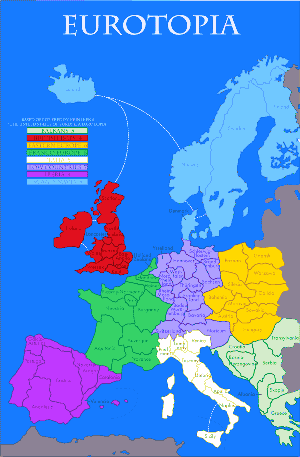
The second turns up on Automatic Earth and is rather longer.  It is about the possibility of an eventual political entity called Eurotopia based on regions rather than nations and is intended to be something like the USA in theory, although in practice may well be far more centralised and dictatorial.


Essentially, the second article suggests that the New Europe might well be based on counterfeit promises and hopes that claim that all the good things in welfare and state provision of the past can be kept and improved on.  If the finances of enough nation states collapse it could happen.

This restoration of welfare rights and privileges would be done by such a New Europe and a surrender by the nation states to allow their territories to become separate regions and all those regions to be embodied in the grand empire of Eurotopia.

Except that it won’t work.  But Peter Sutherland is one of the Eurotopians who has been attempting to drive Britain (he is Irish) down that road for a long while now.  In doing so he has made some strange friends, Colonel Gaddafi for one, as well as others.  Also he remains a Goldman Sachs man to the core.

So in Eurotopia and with it a salvaged Euro who will actually holding the purse strings and dictating the policies, Goldman Sachs and their friends reunited?  Who from the UK would be prominent at the head of affairs?


Saturday, 11 August 2012

Saving Vice President Ryan


When Mitt Romney announced his running partner in the upcoming Presidential Elections he claimed that Paul Ryan would be the next President of the United States.  This caused some confusion in the UK media, not alive to the nuances of American politics.  It is simply that Mitt doesn’t really “do” autocue.

Errors apart, when Ryan emerged from a hatch on the USS “Wisconsin”, laid up at the US Norfolk Navy base nautical museum he was improperly dressed.  My Chief Petty Officer uncle would have had him doubling back to put on a tie as well as looking forward to some unwelcome fatigues.

The event was replete with irony.  Doubtless, as Ryan is a Wisconsin man, it might have seemed a nice idea.  However, to emerge from a vessel that has spent time bombarding Japan, Korea and sailing the South China Seas to assert American power, let alone its more recent role in the Gulf War is a tad tactless.

More to the point is that the Nauticus Maritime Centre at which it is based has a good deal to say about Pirates and their intimate connection with US history, one way or another. 

With the questions about Mitt’s money and where it is becoming a major issue that a great deal of is claimed to be located in former pirate locations and bases it almost invites derision from some quarters.  But there is a greater problem that that.

A major economic concern in the US is the current trade deficit, but it may not be just a question of the actual movements of imports and exports, it is a lot more complicated than that. 

In this item, hat tip to Tax Research, it is argued that the way money is shifted in theoretical payments and pricing may now create a fundamental continuing deficit in the balance of US trade that could be impossible to correct.  If this applies also to the UK, then we are in worse trouble than we think.


Again, in this we are back to many of the former pirate locations.  Many of them are part of the UK network of financial centres.  Necessarily, the Democrats are very likely to make this a prime target of their campaigning, so if President Obama were re-elected this could invite more hostility to London as a financial centre.

The trade deficit debate is inextricably part of the issues raised by the relocation and outsourcing of so many jobs across US industry and commerce.  Again, the same applies both in the UK and Europe.  This is not going to go away.

We are winding up to a grim contest in the US, just at a time when Europe is in increasing disarray and in the UK the government is weak and divided.  Between them all is the hope of putting things off in the hope of some economic upturn.

Also Paul Ryan is apparently a follower of the guru Ayn Rand, whose ideas are said to lie behind much of the present debacle.  This is not good news for those who are looking for a US leadership with both clear economic and practical policies for the future.

With too many problems stacking up too quickly and other crises pending if things go wrong a US Election between an Administration of patchwork policy and opponents looking back to a non-existent past is not going to deliver the men we need.

Friday, 10 August 2012

How To Win The Euromillions Lottery


Tonight, Friday, it is said that the main prize in the Euromillions lottery will amount to over £140 million pounds.  For personal reasons known only to the credit check companies, the county courts, sundry bailiffs and persons seeking me at previous addresses, I could do with a slice of the action.

So I will pledge my new trainers as security for a modest loan from a payday loan company that advertises on the net.  The cash from this will be used to justify another, rather larger loan from a high street bank.

Then I shall create a new financial instrument called Trainer Bonds and launch these around the financial networks.  By dint of high leverage and rapid deployment of monies plus setting up a chain of companies in offshore locations funnelling funds through other centres the sums available will become very large.

So large that I will be able to outsource the calculations I need to one of the worlds major computer facilities.  This will enable me to buy one ticket of every possible number in the Euromillions draw.  This means I win.  However, there appear to be one or two slight problems.

One is that the interest and charges on all the financial transactions and loans will exceed the prize money by a great deal.  The other is that the capital debt cannot be repaid in any way.  In short, Trainer Bonds will have become a “toxic” part of the world’s financial system.

All is not lost, because having put the world in peril of systemic financial collapse causing the end of civilisation as we know it, but more important causing inconvenience and embarrassment to all the world’s elites, I will need bailing out.

The Fed, the Bank Of England, the EU, the Eurozone, the IMF and the rest will have to come up with a package to sort it all out.  With any luck they will have to allow me to keep the prize money in order to prevent any further activity on my part.

Then I will be able to afford the new pair of trainers I need, but was unable to get because I maxed out my credit card.

Pure fantasy, of course, nothing like this could happen in real life.


Thursday, 9 August 2012

Avez Vous Un Cuppa


Wheels with wheels, as the saying goes.  We are now at the point when France may want to expel the UK from the EU.  Our cyclists have done better than theirs and they don’t like it up them.  Dark allegations have been made about the technology of the wheels used by British riders; alas they seem to have been sourced from France.

During the televising of the cycle racing by the BBC in the Velodrome fleeting glimpses were caught of John Major, Prime Minister between 1992 and 1997.  No reference was made to him as he has become almost the forgotten man of the last three decades. 

But it was on his watch in 1994 that the Manchester Velodrome was constructed and became the home to the National Cycling Centre whose work has been central to the rise of British Cyclists.  Give the man some credit for having done at least one thing right.  What if nothing had been done then?

Also, not mentioned on the BBC coverage is that BSkyB have been sponsors of British cycling since 2008 and the formation of Team Sky in 2009 to become one of the leading teams in world cycling has had its impact on the development of some of our champions.  Difficult one that, but it should be mentioned.

Also difficult are the brutal realities.  There are now calls for much more spending on sport for all and everyone.  That a good many youngsters seem to be shy of the time, effort, expense and the rest involved in relentless sport is understandable as there are now many other things to do.

Inevitably, some potential winners may be lost, but how many are lost in any case because whilst being potentially good at a sport involves such commitment that it may be too much for either them or their families? 

One option is to remove them from their homes and families and drill them hard, as some states do, but I doubt that this is possible in the UK.

But when the head of the National Cycling Centre was interviewed on TV, he was asked by the interviewer if their overall work had to be “ruthless”.  He denied this interpretation saying that it had to be honest, even if some people thought that harsh. 

The upshot of this is that the work of the NCC is highly selective and has to be to deliver the prizes.  In the UK and notably in politics and the media this kind of notion is not welcome and rarely enters the discussions about how best to do some things. 

We are happy to watch the races and cheer the winners but not happy about the idea of concentrating resources on them.  We have become too used to scattering state money and favours around without too much regard to whether it really pays or not.  This involves difficult choices and an honesty of purpose which almost all our politicians prefer to avoid at all costs.

Another intriguing aspect is that cycling coverage was rare in the mainstream media for a very long while.  It was regarded as something the “peasants” did to amuse themselves.  Meanwhile on BBC there were often wall to wall equestrian events which the lower classes were instructed to admire.

It was not until the early 1980’s that the newly established Channel Four began to run regular items on cycling such as the Tour de France.   For most people cycling on TV was restricted to occasional advertisements.  The most famous was the 1971 Tetley Tea Bags commercial lasting thirty seconds, see below:


Watching the advertisement and considering the new attraction of cycling both David Cameron and Boris Johnson have used cycles in their efforts for popular self promotion.  It would save a lot of politicking if they did a best of three 1500 metres race for the Premiership.

The idea could be extended if we really did want to promote almost compulsory sport for everyone, government office would be available only to these meeting high time or performance targets in their chosen sports.  Given that all of them seem to be missing every possible other target it might be more effective.

Although one thing should be clear.  It would be no use whatsoever for Cameron and Clegg to team up for a tandem race.