Tuesday, 3 July 2012

Learning Curves


Over at Tax Research and Richard Murphy he comments on the appointment of Ian Barlow, a KPMG man, to head the HMRC, our office for the income tax, revenues and the rest.  He points to some interesting features of KPMG during Ian’s time there and wonders what kind of fit this is in being the UK tax boss.

KPMG are located in any tax haven worthy of the name and are one for the leaders in the field of arranging tax avoidance packages and other funny money deals.  But he may be a poacher turned gamekeeper or a latter day Paul of Tarsus falling off his horse whilst riding round Chipping Norton.

If this one happens, then you would certainly have heard it here first.  Is Bob Diamond, formerly of Barclays, now a shoe-in to be the next Governor of the Bank of England in succession to Sir Mervyn King?  Expect the announcement on the day of the 100 metre finals at the Olympics.

The Bank of England could certainly do with repositioning as we call it in the public bar.  Making it a major profit centre for The Treasury with a brief to keep the UK at the forefront of trading invented stock and adjusting interest rates to suit would do wonders for the economy, one way or another.

It may be time for some imaginative initiatives for the City of London because there are those who think the future may not look too bright.  If you have two minutes and twenty three seconds try this link from Jack Crooks in Money and Markets:


The question then is what to do with Sir Merv’?  Obviously put him in charge of something big, hopelessly disjointed, failing, pushing families into debt and spending vast amounts of the taxpayers money.  Yes, make him Tsar of Education! 

Well, maybe not a Tsar in view of what happened, perhaps Viceroy might be a nice title to pluck from the past.  One area badly in need of vigorous reform is that of the teaching of mathematics.

In line with modernist educational practise, we could encourage our youngsters to go in for Creative Mathematics and hope we might nurture a generation of creative accountants that would help to maintain the City of London and the UK at the centre of the global financial system.

Taking the picture from Zero Hedge, the government could call it the Mary Poppins Policy.


Monday, 2 July 2012

Telling Tales


Um, let me try to work this one out.

The government have been subsidising financial institutions to fake the interest rates to enable money flows that enable the government to do things off balance sheet that enable it to fake the data on which they base economic and budgetary policy.

This is why I pay more in taxes, why my savings earn interest rates at the lowest level in my life, why my obligations to a whole raft of service providers increases in cost more than the posted inflation figures and why when moving money it is taking several visits to the bank to persuade them to let me use my money.

This kind of thing is supposed to be new.  Those of us who have delved into the history of economic crashes, financial malpractice and money know that for long before the 20th Century this was the norm, notably in Britain and Ireland.

It took two world wars and the huge disruptions that followed to put in place laws and arrangements that were rather more reliable and equitable.  The more open politics and the demands of ordinary people with votes helped towards this.

Then we threw it all away in the final quarter of the 20th Century.  There were many reasons for this.  One was the consolidation of the media and its merging into the structure of politics.  The other was that we were offered an impossible future.

Power was not for the ugly, the academic or the plain ordinary man or woman.  It was for the pretty, the persuasive and the pampered who offered us easy money and easier living, all of which we now have to pay for.

In some parts of the media there are commentators who are telling us to blame ourselves because we liked it that way.  Some of us did, many of us were told we had no option.  In any case our children were targeted to demand more.

What also was lost was the moral imperative that affected much of politics in the middle years of the 20th Century.  It was always a tenuous proposition and often politics was at the margins of it but there was enough to remind us of folly.

What is striking is that in all the recommendations for this history or that history to be taught to our children it is impossible to find even in the history which is taught any reference to the financial background to so many of the disasters of the past.


There is an old hymn, “Tell Me The Old Old Story” which refers to the Bible.  In reality the old old story is that if you let people loose and allow them to control the monetary systems and methods they will almost certainly abuse them for profit and leave misery and mess in their wake.

Then all you can do is pray and probably that will not work.

Sunday, 1 July 2012

Bending To The Wind


As we watch the strange political contortionist act being put on by David Cameron as he tries to bend three or more ways at once we wonder how good; or rather bad, a Prime Minister he is. 

At present we view him in the light, or rather darkness, of Blair and Brown with occasional references by those on the Left to Margaret Thatcher.  The forgotten man is John Major and perhaps we should begin to see Cameron as Major Mark 2.

Major was once employed by Standard Chartered Bank, lucky enough to get in at a time when overseas banking was becoming an expanding racket.  He has remained connected to the trade ever since in a quiet way.

Also, he was at the Treasury and in government when the thrust was made to free the City and others of a great deal of regulation and enabled the Big Bang of the 1980’s when our modern banking and financial system began to take shape.

Then he was Foreign Secretary and much involved in Europe and in the Exchange Rate Mechanism and other dealings.  He seems to have accepted Europe and for the most part agreeing with the way things were going and intended to go.

As Prime Minister with a small majority whilst it was one party there was a deep divide amongst them over Europe.  So it was more of a coalition than a united party and Major certainly did not like the critics of Europe and its deniers.

So an interesting question is that if Major had won a big enough majority in 1997 would he have been able to force through the UK entry into the Euro zone?  As Cameron was close to Downing Street one way or another during all this time was he one of EU and Euro fans?

Major lost the 1997 election largely because of a series of political calamities and scandals.  With Cameron looking accident prone and evidently unwise in his choice of close advisers and connections he is beginning to look doomed in the same that Major did after around 1994.

And 1994 was the year when Cameron went to Carlton Communications with all the media and other connections.  Major often found it difficult to make up his mind.  But this was at a time of rising prosperity and when things were thought to be progressing.

Cameron is in the middle of a major financial crisis and the potential collapse of much of the system he grew up with politically and personally.  So what is the Conservative Party going to do if the game is up with him?

Struggle on in the hope that something with turn up or dump him as soon as possible and find someone more convincing and certain about Europe?  If they don’t they could soon find themselves out of office for another long spell.

Time is very short because the Parliamentary Summer Break is close.  By the time they all return the world might be a different place.

Saturday, 30 June 2012

Thought For The Day


In our town to celebrate the Diamond Anniversary of HM The Queen, also Head of the Church of England, a pedestrian area was created to host events and communal activities. 

It is called, astonishingly, Jubilee Square.

Adjacent to it is a disused furniture shop that has been closed a year or two now.  Application has been made to the Council for a change of use more in keeping with the developing needs of the community, as defined in the local council “Vision”.

Consistent with their existing policy the Council have had recommended to them a new tourist friendly centre and most councillors are set to fully welcome the proposal which is in keeping with recent changes.

It is for a lap dancing and strip club.

Mentioning this to my family one remarked that possibly the chief advantage was that the club would not have to change the name of the facility.

When selling furniture it was called “Loader and Payne”.

Friday, 29 June 2012

Old King Coal


As we lurch into yet another financial crisis or series of crises and pursue our current obsessions  on climate, oil, nuclear, wind turbines and the rest we forget that coal is still around and much used about the globe.

In the UK there are only a few remnants left of our once large and crucial coal industry.  It is possible that there are now more mining museums than there are working pits.  For us the coal industry is history, emotive and real for some, just another heritage thing for others.

It had its interesting features.  A hazard in one area was that for any new developments there could be unknown old workings not far below ground.  So as soon as the foundations or buildings went up then they would soon go down into a big hole.

A particular menace was the bell shaped pits dug by the monks at local monasteries.  If one was found then it would be inevitable that you would have a cluster of them on your hands. 

The council’s informal policy was simple.  Quietly fill them with rubble, put a covering of soil on top and sell off the land for private housing.

With a hat tip to the Oil Drum, here is an article from the Peak Prosperity blog that tells us about coal and its use around the world and that it remains a primary resource of key and continuing importance.  More and more is being mined and used and there is a lot more to be had.

It is a substantial article but with plenty of graphs and certainly enough to make one wonder whether we know the half of what the future may have in store.


At the bottom you will need to click on the Part II “Coal is the fuel for a world in decline” for the short ending.  The final sentence is:

Quote:

“It’s not surprising, therefore, that each time the global economy weakens and then rebounds, its hunger for coal advances more strongly.”

Unquote.

So our easy assumptions about much of the energy needs of the world and how they might be met on the basis of international agreements may be only a charade in the real productive world.  Coal, if not King, can still command a princely price.

The picture above is of the Hickleton Main Prize Band in the early years of the 20th Century.  This colliery was located at Thurnscoe in the Dearne Valley.  My lady’s grandfather died there in 1912 in an accident.  He lies in the Orgreave Cemetery in Sheffield.


Thursday, 28 June 2012

A Fleet Of Fools


The latest ructions in the UK banking sector are causing a flurry of activity in the media and politics.  Barclays probably along with others have been up to no good.  RBS sacked lots of IT and back office people, outsourced to India and then rediscovered Murphy’s Law (see Wikipedia).

But in all the “Extraordinary Delusions And Madness of Crowds” (see Wikipedia re Charles Mackay’s book of 1841) a number of lessons have been ignored.  Under my nose at present is a book “The General Theory of Employment, Interest and Money” published in 1936 by John Maynard Keynes.

He was a man of formidable intellect and analytical powers.  It was Keynes who argued that the Classical Economics which ruled much of academic and political thinking on the subject no longer worked.  His exact words in the brief Chapter One were:

“Moreover, the characteristics of the special case assumed by the classical theory happen, not be those of the economic society in which we actually live, with the result that its teaching is misleading and disastrous if we attempt to apply it to he facts of experience.”

The world has turned upside down more than once since he wrote those words.  Had he been spared two decades longer we can only guess at what revisions he might have made to the structure of his theories and the application of monetary policies that he might have suggested.

In 1936 he wanted to show that employment substantially rested on what interest charges were made and what money flows there were.  Investment followed from these and this would generate the spending that enabled employment.

If the markets could not arrange this or were failing, then given uncertainty and the rest it was up to government to manage its own rates of interest and money flows in such a way as to influence both markets and real activity. 

The underlying assumption was that governments could and would do that if they were to overcome their attachment to classical economics and face down those in business or elsewhere.  This also had the assumption that governments did have this control within their own nations.

What has become clear to some, but not all and especially to those still wedded to the ideas of Keynes, is that this assumption of governments being able and willing to act effectively is no longer tenable.  In short what Keynes said of classical theory now applies to his own.

The reality has been that governments ceded control over the quantity of money and the direction of its flows to unregulated markets that went global beyond any real control.  Moreover, it is now clear that the big banks who managed to survive did so by taking control of effective interest rates.

“Investment” is now muddled up with “consumption” and often any spending that adds to money circulation is deemed to be invested.  In any case we are all too aware that the main feature of much government and connected “investment” is a dead loss and has no economic return.

It is often just a series of short term popular “quick fixes” or delusions to keep the media happy.  Consequently, the type and amount of employment that results does not meet either the numbers or the real economic needs required.

So what we have been taught in the last few days, if we did not already realise it is that there cannot any longer be any “general” theory or coherent explanation of what is happening. 

Least of all can governments make any effective decisions because they are prisoners of the global markets which are controlled by nobody except the madness of crowds.  The City of London has become the Bedlam of banking.

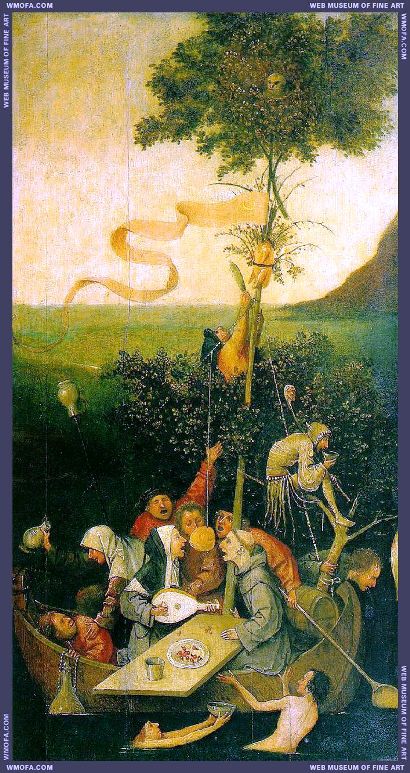
The picture above is “The Ship of Fools” (see Wikipedia), painted by Bosch in the last decade of the 15th Century.  It is an allegory now being quoted widely on the web.

Wednesday, 27 June 2012

How Not To Run A Bank In One Easy Lesson


On the 17th September 1948 the Indian Army and Air Force launched an assault on the State of Hyderabad to dethrone the monarch, Asaf Jah VII, Mir Osman Ali Khan. 

It ended the resistance of one of the last major rulers of one of the Princely States of India who had direct allegiance to the British Crown.

The Nizam of Hyderabad (see Wikipedia) had perhaps hoped that other Princes and rulers would hold out against the new India and retain control over their territories and that the British would honour their various treaties and agreements of the past to support the Princes.

In February 1949 the Government of India finished the job by nationalising the estates of the Nizam and later dismantling its political structure into three separate parts. 

Neither the other Princes nor the British Government offered the Nizam any help or support.  The UK media was decidedly unsympathetic.

As this blog goes in for grim ironies and ghosts from the past to see that the problems at RBS/Nat West/Bank of Ulster are said to arise in Hyderabad from some botched IT work causing a cascade of breakdowns in their systems is another notch on the butt.

My mistake was to comment on this to someone close to me.  As this person has had long experience in banking notably in back office work and operations control strong opinions were forthcoming. 

Whilst the key error may have been made by a humble minor employee the view was that this major failure should not have happened. 

What was at fault was not just higher management in Hyderabad but the whole ethos and systems of management at the head office of the bank. 

The top management in its own field of activity in the past went catastrophically bust and clearly when it came down to the hard work, making sure the ordinary service banking bit worked, they proved to be useless.

It is no good calling for this lot to be nationalised.  They already have been.  This is “our” bank that failed in its basic functions. 

Is it time for a fundamental restructuring of this group of banks and should it be done as soon as possible?

Given the uncertainties plaguing the financial markets the failures at RBS etc. could have started a run on the bank.