Wednesday, 8 June 2016

Have You Got Time?


One advantage of the web nowadays is that instead of sweating over a hot typewriter or lurking in libraries you can write pick up information very easily.  Which is why link blogs are popular.

We all need sleep so we all have an interest, hat tip to one of the family.  This longish item from slumber wise may tell us why so many do not sleep well according to the conventional way of our times.  It claims that sleep patterns not so long ago were different.  Our modern practice may not be the best.

Most of us travel and this one from Simon Jenkins of The Guardian, under the heading of The Long Read, hat tip Orphans of Liberty, is about the history and politics of the HS2 project.  This blog has serious objections to the project as an occasional railwayman of the 1950's along with near eighty years moving by train.

What is striking is that it is not just an article dealing with the issues of transport and what may or may not be best.  It is a major example of how our politics and governments function these days and their preparedness to lavish money on high profile projects and activity at the cost of basic activities or less media friendly ones.

One aspect of such projects is that almost invariably the future running costs, maintenance, interest charges on debt are not considered.  The consequence is loss making activity that has to be met by debt, taxes, or pricing in the future.

There are risks unwanted in life and all those with a pensions interest either now or in the future do not like risk.  But Frances Coppola reminds us that life is not like that and that being risk averse is counter productive.  The present situation is getting worse.

What is the point of a Referendum is as the BBC suggests, hat tip The Slog, Parliament may decide to take no notice and indeed frustrate the wish to Leave the EU?  This blog on 27 May last under "Hanging Parliament" suggested it was possible for the Government to effectively block our exit because in Parliament most members at Remainers.

Now is it time for a kip, or a trip, or to check the bank account or to deal with the postal vote?

Monday, 6 June 2016

When The Boat Comes In


The recent debates which are causing tempers to be lost tell us much about our masters.  The former Prime Minister John Major emerged from his prime property investment to cry "Deceit, deceit, they've all got deceit for me!" (see the film "Carry On Cleo") about the Leave campaign.  This is rich coming from someone unable to give a straight answer about anything during his term of office.

One of the quibbles he has is about the migration issue.  For our politicians this is a game played by people who have trouble with any numbers, especially if there are complications or calculations with a need to be very careful about assumptions.  Truth might be found in numbers but only if they are the right ones.

My take on migration is to look at the long historical perspective as well as the numbers.  One of the advantages of the net is that out there is a great deal of information that is useful, if not for, certainty, then at least hinting at where to look and what questions to ask.  At a personal level there can be very many "what ifs".

One fascinating site is Norway Heritage dot com which deals with the large scale migration from there across the Atlantic in the past notably the late 19th Century.  A great deal of it was carried by British ships and the site has extensive records of these and their sailings.  If you have an interest in maritime history it is a treasure trove.

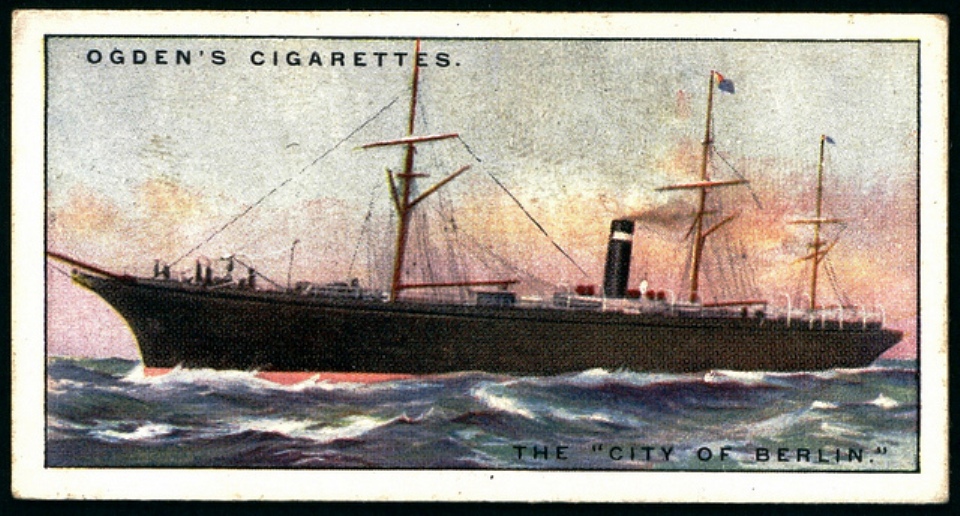
One example is this of the SS "City of Berlin" of the Inman Line, on the Liverpool run.  A great grandfather was in the boiler room for a long period of time and later might have been in charge.  A younger son, he migrated from Co.Wicklow to Liverpool.  It appears that other family connections were involved.

Some of them and their families went across to stay.  Why didn't he?  He lived in a place which was almost a transit camp of peoples at times.  He was crewing on a ship that evidently carried many migrants.  He had the opportunity etc. but he did not.  Perhaps he may have been particular about his beer.

As well as the Scandinavians, who in general were welcomed, during the late 19th Century there were many others.  In the 1870's the USA was adamant about its open doors policy for reasons much the same as we claim today.  Some of their early peoples disagreed but after the US Cavalry had done its job had to accept the economic changes.  Yes, I have marched to "The Garryowen".

The new peoples of later years, however, were not quite the same.  There was large scale movement from Italy, a nation created only by the 1860's, with confused politics, much poverty and economically weak, what changes?  Also, there were many of the Jewish faith driven out of the Russian Empire, which then encompassed Eastern Europe.

But then came others in numbers from the Far East.  This had the potential for large scale mass migration with the relevant demands.  Yes they brought their labour and what money they had, no they did not have the same belief systems or cultures. It was soon after their arrivals that the US began to introduce limitations and later legislation aimed at control.

This was all very recently.  I can recall talking to people born in the 1860's and 70's.  Yet we seem to have forgotten what was really involved and do not understand what is possible.  For large scale movements of the longer past we know and understand even less.

At present, there is small hope of any of our leaders having a grip on the implications or even understanding some of the basic numbers.

Back to the boiler room.

Saturday, 4 June 2016

Short And Long Breaks


The Drama Channel on the satellite is running the 1990's "Cadfael" series about an old monk being the Sherlock Holmes of Shrewsbury Abbey back in the good old days of the 12th Century when men were men and women were domestically busy.

The original running time for each episode was 75 minutes in a slot of one and half hours programming; leaving 15 minutes for the ad's and beginning and end clips.  The present screening has divided each episode into two one hour slots meaning 120 minutes for the same story time and many more ads'.

The plots are complicated with a number of characters, sub plots and mysteries difficult to solve and predict even for the knowing viewer.  So the number of ad' breaks now not only disrupts the actual telling of the story, you begin to lose track of what is going on. If you find the 12th Century difficult you could find it impossible.

Crucially, what had been one programme is now split into two with a week's break.  We have avoided this by boxing both parts and watching them successively. This works up to a point because rather than being slumped back just watching it all happen, I am now clutching the remote to hit the buttons on the breaks to fast forward to get on with the viewing.  At least I "get" the story but not with the enjoyment I might have had.

Yes, I know, I should have bought the DVD's. But that is an added cost and having watched once, or say twice, they just go into the pile of discs never to be watched again.  Also, I know that without the ad's I might not have the TV since it is the marketing that provide the service as well as my sub's.

Those reading this will not need me to say much at all about ad's on the internet.  What I find intriguing is that when having done a search for something to buy I go onto a popular news site and in the content of that site appear ad's for those very things.  Spooky.  But again as the pop up's asking about my ad blocker say the ad's pay for the deal.

Then there is the attrition in the print and the "legacy" media which is happening.  I am sorry to lose them but have to confess that while at one time my local newsagent's bill was a big one now it is zero, so I am part of the problem.  Some of them are going down or online and the shop has closed to the ruin of the nice lady who ran it.

One key issue here in the media is that the marketing men have moved their spend drastically cutting the revenues for print and legacy sectors.  That together with the loss of circulation due to people going online has pushed the margins too tight.

What is strange that while the ad' men and women seem to be gaining control and access to a degree never imagined and are now impossible to avoid, other things are happening.  If incomes and consumer spending is now shrinking in many sectors it may explain why the ad's are becoming shriller, louder and more "in your face".

This post is prompted by A K Haart's one of Thursday, 2nd June on "Branded Dreams - The Future Of Advertising".  The deluges of ads have become tiresome and things to be avoided if possible but if not you just close down mentally and think, if not of Empire or spending, but of any distraction or fantasy that comes to mind.

The BBC in theory does not have ad's but the number, time and content of its own "in house" puffs are beginning to rival the ad's of the commercial channels, but at least at present not at the level or in the breakup of screening.

An effect is that we may now have a population, especially in the younger generations, with reduced attention spans and a brain functioning in a more detached mode most of the time.

On the other hand, perhaps I need to read more, but the bookshop in town means awkward parking, so I have to go online.

Thursday, 2 June 2016

Defence, Deceit And Disgrace


With the Referendum on 23rd June about Europe and the Chilcot Report out a few days later, this post from Friday, 30 October 2009 under the heading "Defence - At The Going Down Of The Sun", near seven years ago, still has relevance. In the last but one paragraph, there is reference to Europe in the context of what had happened in Iraq.

Quote:

In 2003 when Bush and Blair launched the invasion of Iraq, I wrote a letter to a journal stating my doubts about the viability of the UK involvement.  It was printed.

The words I used have come back to haunt me, in that I wrote that “just in time” supply and management ideas applied to armed forces in action were a dangerous and damaging nonsense and liable to result in setbacks, risk defeat and lead to many unnecessary casualties.

My reason for writing was that I had looked at the figures, of men, material and support, and had concluded that not only were our troops in action overstretched, but that the supporting elements were far too few and too dependent on long distance logistics to maintain any campaign of substance or length.

Long ago I was one of a handful who had the job of keeping the log on the operational capability of the formation in which we served.  Our job was to know where every tank was, every tank transporter, and their capability, with other information, so that they could take the field at one hours notice with all the supporting elements.  In the field the situation had to be monitored continually.

It was clear that the UK Iraq project was being done without the necessary forces and support, and that everything depended on the Yanks being able to knock out the Iraqi’s within days rather than weeks.

It has been stated now that in the late 1990’s, notably under Brown’s control of spending, and Blair’s cut and shuffle politics of defence, applying concepts of business management based on the supply of frozen peas, detergents and DVD players to the waging of a bitter war was the reality.

Engaging in military operations is inherently unpredictable, subject to daily major uncertainties, means losses that are incalculable, and requires large scale storage of essentials and the ability to move them at any distance at any time.

It applied to the situation that created the recent disaster of the Nimrod Aircraft.  In relation to our ground troops in Iraq and Afghanistan, Armies, Air Forces, and Navies fighting in the East are not operated like supermarkets in Dunfermline or Sedgefield.

Fighting enemies are not campaigns to gain marketing share, however much the bonus rich bankers and commercial executives in comfy offices peddling poisonous products would like to think.  But these are the people that our politicians listen to.  Having wrecked our economy and our health, they have been allowed to wreck our military capability.

As the Forces have too often learned in the past, supply and provisioning is critical to success or failure.  In 1833, the government of the day, against Wellington’s advice, disposed of the supply Land Trains established in Napoleonic Wars.

One result was the fiasco in the Crimean War when soldiers starved, froze and died of dysentery and worse.  It does not apply only to the UK, Google “Napoleon-Moscow-1812” or “1941 Barbarossa”.

We have been very fortunate in Iraq and Afghanistan, the Yanks are there to plug the gaps and avoid the worst of the consequences without much in the way of complaint or sending the bills.  Little has been seen about this.

Left to Blair to organise, Brown to fund and the smarmy back scratching crew of hopeless inadequate political greasers at the Ministry of Defence to manage it would have been a great deal worse.

As it is too many good men have been sacrificed, we are now almost helpless to defend ourselves at home or abroad, and all the government can do is to run to Brussels and Europe to hand over the responsibility.

Blair, Brown, and their cabals may be War Criminals, but let us not forget that above all they are traitors.

Unquote.

It will be interesting to see what Sir John Chilcot has to say.

Wednesday, 1 June 2016

Looking For Money


The current debates on so many areas of policy now are becoming so intense, it is becoming difficult to be moderate.

In the Europe matter both sides claim to be the winners and the other the losers.  It might be a matter of chance.

The most rational illustration I can think of is this four and a half minute clip from the musical "Paint Your Wagon".  The song that begins it is as below.

The concept that striking gold can entail a funeral is very apt.

Gotta dream boy
Gotta song
Paint your wagon
And come along

Where am I goin'?
I don't know
Where am I headin'?
I ain't certain
All I know
Is I am on my way

When will I be there?
I don't know
When will I get there?
I ain't certain
All that I know
Is I am on my way

Monday, 30 May 2016

Who Owns The Land?


The property market and ownership is and always has been a key area in the economy of the nation at different levels.  The one that obsesses us at present is its prominence in financial services which in turn have become so important.  This can lead us to forget that if affects all our lives and in many ways.

One of the basic services and perhaps the key asset in how we manage and record property in the UK are The Land Registries.  Wikipedia has a page on Land Registration that briefly sets out what it is and what it does and The Land Registry for England and Wales is described.

We take it very much for granted, often just regarding it as one of those bureaucratic fees that have to paid when buying and selling.  But a basic efficient, low cost, reliable and accessible Registry is crucial to getting the business done and keeping a record of who owns what land where.

Without this, as in the past, property ownership, claims to it and buying and selling could become a legal nightmare.  The reason for its existence after 1925 as compulsory as opposed to the late 19th Century voluntary system was the number of court cases, often  costly, and the length of time it took to get even basic decisions.  Also, increasing local taxation depending on property tax needed a reliable base.

Now our government have decided to sell it to the biggest buyer and it is likely that ownership of this basic national legal asset will go to a finance company based abroad and beyond UK jurisdiction.  It will also have an effective monopoly and it is probable that the charges will increase substantially to allow the company to cream off profits at a level for trading purposes and to allow it high leverage.

What has not been considered by the government, Cameron, Osborne and Sajid Javid, are the real potential risks and the implications. Javid's background of Chase Manhattan and Deutsche Bank, the land of lost mortgage titles in the USA and CDO's lost in the ether, does not inspire confidence.  In his time at DB it took out a lien on the company that has most of the UK's retirement properties, which is owned by a trust based in The Cayman's belonging to some interesting people, contributors to the Conservative Party.

If The Land Registry sale were to result down the line in major problems, this will not mean simply some administrative hiccups to be sorted or computer glitches, it could entail a disastrous failure across the property market.  Present Council Taxation needs this information base.  More important one of the most important and key records for both government and private land and property activity effectively could be out of use or even lost.

There may be a reason for this and if it is a factor it should give us all alarm never mind concern.  It is all too clear in London and to a lesser extent elsewhere that a great deal of property has become a store of wealth for people engaged in asset stripping of nations, corruption, embezzlement, crime, money laundering and the rest.

In short, it has little to do with the real housing market and a lot to do with hiding the stolen money with a little help from your friends.  We do know just how friendly a number of our leading politicians recently have been to the super rich and their interests.  If the Land Registry is removed and cannot be accessed by the curious then neither ordinary interests nor tax authorities can check up on property and the money movement involved.

The New Economics Foundation has a blog item from 2015 which is short and to the point  Quite why the media have taken so little interest in this given the number of TV programmes devoted to property and the extent of the typical coverage is a mystery.  The Guardian has just had a brief and superficial comment on the fact that it is a privatisation.  Private Eye has been pursuing this and the latest issue does have something to say.

What next?  An obvious target is The National Archive, all that expensive vellum, paper, space and people.  Why not flog it off to a concrete making company that specialises in liquidised waste paper as part of the fill?  No more hard copy, just digitise the lot and give Google the job.

The simple question is would you really hand over the deeds to your house as a guarantee to a door to door salesman who is selling insurance from a company based in The Caymans funded by some unknown Russians?
        

Saturday, 28 May 2016

Meddle And Muddle In The Middle East


The centenary anniversary of the 1916 Sykes-Picot Agreement between the UK and France during World War One is not being celebrated but if anything recalled as one of the causes of the present troubles of the Middle East.

Much of our view of the Middle East in that period is gained from Lawrence of Arabia, above, of legend and of film.  It is a complicated and intricate story beginning a century before then that was overshadowed by the events in Europe.

This article in Project Syndicate by Richard N. Haass points out that essentially because of the problems arising from the collapse of The Ottoman Empire its purpose was to avoid conflict between France and the UK as to who had which sphere of influence or control.

The Agreement worked until the Suez Crisis of 1956 when a bungled joint intervention to deal with the ambitions of President Nasser of Egypt led to a collapse of their authority in the Middle East in line with their retreats from Empire.

Then in the context of the 1950's it was the interests of the USA and Soviet Russia that led to a kind of settlement without a settlement.  One upshot of this was the toleration of local despots who had their own ways of dealing with internal opposition or resistance.

Recently, this has broken down and the disintegration within many of the states has led to the present situation.  The urge to meddle in them is not backed by the ability to enforce order or establish a coherent governing regime.

So we may be left with states that are not states and the borders that have existed for a century, the lines on maps, are becoming meaningless.  Historically, it is just another shift in pattern, there have been many of them down the millennia.

But the Middle East is where a lot of the oil comes from and as such is central to both economies and international financial systems.  It is unlikely that Turkey can be a new Ottoman Empire and no other power or combination exists that can.

So it is likely that extremism is probable, conflict between population groups persistent and movement of population substantial.

Welcome to the new millennia, or is it going to be a return to something like the first millennia of the common era?