Sunday, 1 July 2012

Bending To The Wind


As we watch the strange political contortionist act being put on by David Cameron as he tries to bend three or more ways at once we wonder how good; or rather bad, a Prime Minister he is. 

At present we view him in the light, or rather darkness, of Blair and Brown with occasional references by those on the Left to Margaret Thatcher.  The forgotten man is John Major and perhaps we should begin to see Cameron as Major Mark 2.

Major was once employed by Standard Chartered Bank, lucky enough to get in at a time when overseas banking was becoming an expanding racket.  He has remained connected to the trade ever since in a quiet way.

Also, he was at the Treasury and in government when the thrust was made to free the City and others of a great deal of regulation and enabled the Big Bang of the 1980’s when our modern banking and financial system began to take shape.

Then he was Foreign Secretary and much involved in Europe and in the Exchange Rate Mechanism and other dealings.  He seems to have accepted Europe and for the most part agreeing with the way things were going and intended to go.

As Prime Minister with a small majority whilst it was one party there was a deep divide amongst them over Europe.  So it was more of a coalition than a united party and Major certainly did not like the critics of Europe and its deniers.

So an interesting question is that if Major had won a big enough majority in 1997 would he have been able to force through the UK entry into the Euro zone?  As Cameron was close to Downing Street one way or another during all this time was he one of EU and Euro fans?

Major lost the 1997 election largely because of a series of political calamities and scandals.  With Cameron looking accident prone and evidently unwise in his choice of close advisers and connections he is beginning to look doomed in the same that Major did after around 1994.

And 1994 was the year when Cameron went to Carlton Communications with all the media and other connections.  Major often found it difficult to make up his mind.  But this was at a time of rising prosperity and when things were thought to be progressing.

Cameron is in the middle of a major financial crisis and the potential collapse of much of the system he grew up with politically and personally.  So what is the Conservative Party going to do if the game is up with him?

Struggle on in the hope that something with turn up or dump him as soon as possible and find someone more convincing and certain about Europe?  If they don’t they could soon find themselves out of office for another long spell.

Time is very short because the Parliamentary Summer Break is close.  By the time they all return the world might be a different place.

Saturday, 30 June 2012

Thought For The Day


In our town to celebrate the Diamond Anniversary of HM The Queen, also Head of the Church of England, a pedestrian area was created to host events and communal activities. 

It is called, astonishingly, Jubilee Square.

Adjacent to it is a disused furniture shop that has been closed a year or two now.  Application has been made to the Council for a change of use more in keeping with the developing needs of the community, as defined in the local council “Vision”.

Consistent with their existing policy the Council have had recommended to them a new tourist friendly centre and most councillors are set to fully welcome the proposal which is in keeping with recent changes.

It is for a lap dancing and strip club.

Mentioning this to my family one remarked that possibly the chief advantage was that the club would not have to change the name of the facility.

When selling furniture it was called “Loader and Payne”.

Friday, 29 June 2012

Old King Coal


As we lurch into yet another financial crisis or series of crises and pursue our current obsessions  on climate, oil, nuclear, wind turbines and the rest we forget that coal is still around and much used about the globe.

In the UK there are only a few remnants left of our once large and crucial coal industry.  It is possible that there are now more mining museums than there are working pits.  For us the coal industry is history, emotive and real for some, just another heritage thing for others.

It had its interesting features.  A hazard in one area was that for any new developments there could be unknown old workings not far below ground.  So as soon as the foundations or buildings went up then they would soon go down into a big hole.

A particular menace was the bell shaped pits dug by the monks at local monasteries.  If one was found then it would be inevitable that you would have a cluster of them on your hands. 

The council’s informal policy was simple.  Quietly fill them with rubble, put a covering of soil on top and sell off the land for private housing.

With a hat tip to the Oil Drum, here is an article from the Peak Prosperity blog that tells us about coal and its use around the world and that it remains a primary resource of key and continuing importance.  More and more is being mined and used and there is a lot more to be had.

It is a substantial article but with plenty of graphs and certainly enough to make one wonder whether we know the half of what the future may have in store.


At the bottom you will need to click on the Part II “Coal is the fuel for a world in decline” for the short ending.  The final sentence is:

Quote:

“It’s not surprising, therefore, that each time the global economy weakens and then rebounds, its hunger for coal advances more strongly.”

Unquote.

So our easy assumptions about much of the energy needs of the world and how they might be met on the basis of international agreements may be only a charade in the real productive world.  Coal, if not King, can still command a princely price.

The picture above is of the Hickleton Main Prize Band in the early years of the 20th Century.  This colliery was located at Thurnscoe in the Dearne Valley.  My lady’s grandfather died there in 1912 in an accident.  He lies in the Orgreave Cemetery in Sheffield.


Thursday, 28 June 2012

A Fleet Of Fools


The latest ructions in the UK banking sector are causing a flurry of activity in the media and politics.  Barclays probably along with others have been up to no good.  RBS sacked lots of IT and back office people, outsourced to India and then rediscovered Murphy’s Law (see Wikipedia).

But in all the “Extraordinary Delusions And Madness of Crowds” (see Wikipedia re Charles Mackay’s book of 1841) a number of lessons have been ignored.  Under my nose at present is a book “The General Theory of Employment, Interest and Money” published in 1936 by John Maynard Keynes.

He was a man of formidable intellect and analytical powers.  It was Keynes who argued that the Classical Economics which ruled much of academic and political thinking on the subject no longer worked.  His exact words in the brief Chapter One were:

“Moreover, the characteristics of the special case assumed by the classical theory happen, not be those of the economic society in which we actually live, with the result that its teaching is misleading and disastrous if we attempt to apply it to he facts of experience.”

The world has turned upside down more than once since he wrote those words.  Had he been spared two decades longer we can only guess at what revisions he might have made to the structure of his theories and the application of monetary policies that he might have suggested.

In 1936 he wanted to show that employment substantially rested on what interest charges were made and what money flows there were.  Investment followed from these and this would generate the spending that enabled employment.

If the markets could not arrange this or were failing, then given uncertainty and the rest it was up to government to manage its own rates of interest and money flows in such a way as to influence both markets and real activity. 

The underlying assumption was that governments could and would do that if they were to overcome their attachment to classical economics and face down those in business or elsewhere.  This also had the assumption that governments did have this control within their own nations.

What has become clear to some, but not all and especially to those still wedded to the ideas of Keynes, is that this assumption of governments being able and willing to act effectively is no longer tenable.  In short what Keynes said of classical theory now applies to his own.

The reality has been that governments ceded control over the quantity of money and the direction of its flows to unregulated markets that went global beyond any real control.  Moreover, it is now clear that the big banks who managed to survive did so by taking control of effective interest rates.

“Investment” is now muddled up with “consumption” and often any spending that adds to money circulation is deemed to be invested.  In any case we are all too aware that the main feature of much government and connected “investment” is a dead loss and has no economic return.

It is often just a series of short term popular “quick fixes” or delusions to keep the media happy.  Consequently, the type and amount of employment that results does not meet either the numbers or the real economic needs required.

So what we have been taught in the last few days, if we did not already realise it is that there cannot any longer be any “general” theory or coherent explanation of what is happening. 

Least of all can governments make any effective decisions because they are prisoners of the global markets which are controlled by nobody except the madness of crowds.  The City of London has become the Bedlam of banking.

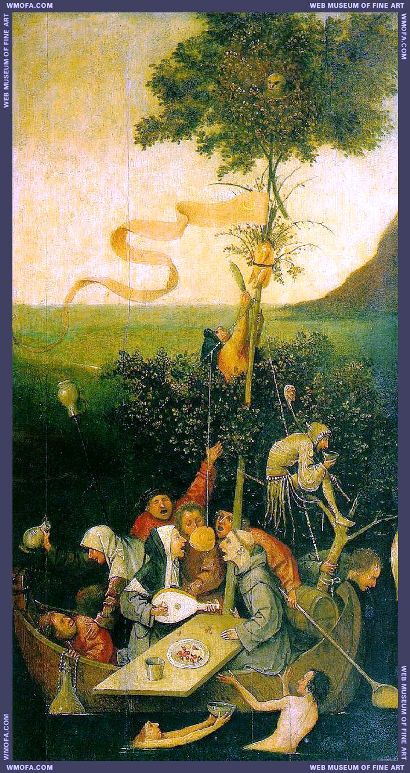
The picture above is “The Ship of Fools” (see Wikipedia), painted by Bosch in the last decade of the 15th Century.  It is an allegory now being quoted widely on the web.

Wednesday, 27 June 2012

How Not To Run A Bank In One Easy Lesson


On the 17th September 1948 the Indian Army and Air Force launched an assault on the State of Hyderabad to dethrone the monarch, Asaf Jah VII, Mir Osman Ali Khan. 

It ended the resistance of one of the last major rulers of one of the Princely States of India who had direct allegiance to the British Crown.

The Nizam of Hyderabad (see Wikipedia) had perhaps hoped that other Princes and rulers would hold out against the new India and retain control over their territories and that the British would honour their various treaties and agreements of the past to support the Princes.

In February 1949 the Government of India finished the job by nationalising the estates of the Nizam and later dismantling its political structure into three separate parts. 

Neither the other Princes nor the British Government offered the Nizam any help or support.  The UK media was decidedly unsympathetic.

As this blog goes in for grim ironies and ghosts from the past to see that the problems at RBS/Nat West/Bank of Ulster are said to arise in Hyderabad from some botched IT work causing a cascade of breakdowns in their systems is another notch on the butt.

My mistake was to comment on this to someone close to me.  As this person has had long experience in banking notably in back office work and operations control strong opinions were forthcoming. 

Whilst the key error may have been made by a humble minor employee the view was that this major failure should not have happened. 

What was at fault was not just higher management in Hyderabad but the whole ethos and systems of management at the head office of the bank. 

The top management in its own field of activity in the past went catastrophically bust and clearly when it came down to the hard work, making sure the ordinary service banking bit worked, they proved to be useless.

It is no good calling for this lot to be nationalised.  They already have been.  This is “our” bank that failed in its basic functions. 

Is it time for a fundamental restructuring of this group of banks and should it be done as soon as possible?

Given the uncertainties plaguing the financial markets the failures at RBS etc. could have started a run on the bank.


Tuesday, 26 June 2012

Migration And Muddle


There has been comment that the Rio conference has gone for “economic growth” rather than the inconvenient 1992 decision to pursue the will o’ the wisp of “sustainability”. 

Well, of course as the population of the world rises and as more fiat money is pumped out to deal with the consequences all the figures will indeed show “growth”.  The trouble is that this will not be equally shared.  The other problem is that the “growth” may not be half enough to cope with the consequences.

Over a decade ago I was at a session at the LSE where someone expert in the study of the environment was trying to explain what he understood by “sustainability”.  He did this by using the idea of the “footprint” of major urban areas on the world and the amount of resources and effort needed to sustain each and any of them.

He suggested that the competition for the earth’s resources was likely to increase and as these were not distributed evenly this had implications.  Given the history of the world in the past this meant that uneven distributions of apparent wealth and access to resources generated activity that in many cases was far from peaceful.

In the absence of effective world government or any hope of it and given the rival needs and ideas in the existing political structure it was inevitable that a good many stresses would develop and conflicts arise of both states and interests within states.

One area of probable difficulty would be the movement of people and in some cases populations and the impact it might have.  He skirted this issue delicately, but did say that one way or another the nations heavily involved in foreign trade and finance would be at the centre of this, in short the UK had a problem.

During the questions up popped a lawyer from over the road at The Temple to declare that as far as the UK was concerned there should be no question of any control of immigration and that it should be unlimited.  This was in pursuit of the ideals of human rights and free movement.

He was adamant that we could and should afford it.  The speaker made some generalised comments and moved on quickly to the next question.  The lawyer concerned was very well connected and it was wise not to offend him.

This appears to have been the mindset of the small group central in the Labour government of 1997 to 2010.  There are two key aspects to this.  One is that it did not seem to occur to any of them to run the numbers or look at the realities.  The other is that this occult wish fulfilment to transform us all was born from a long past.

If you take those areas of the world that were once the Empire, add up their populations and then add some other places from whom people may want to move for various reasons and you have a lot of people, call it between two or three billion.

Consequently if only quite small minorities from all these places head for the UK then this country is looking at some big figures relative to the size of its population.  The UK has a free on demand health service, a generous little controlled benefits system and a social housing policy that is attractive to incomers.

If the countries from which these minorities move do not have these advantages and on the whole are much poorer with limited urban and social facilities then the UK will have a strong attraction.  Once established the chances are that these minorities could then grow rapidly in numbers of incomers.

How we have arrived at the present situation has a long history.  It begins before Empire with the wars of religion when it was a matter of faith to welcome Protestants and others.  During Empire the education of our elite was based on the ideals of Ancient Rome and its ideas about citizenship.

Alongside this other political groups were attracted to ideas about internationalism and the working classes and in diversity of culture.  Some sixty years and more ago I became acquainted with these ideals through the Council for Education in World Citizenship. 

During the 50’s and into the 60’s many Conservatives were still bound by notions of Commonwealth, the Sterling Area, world influence and all the rest.  On the other hand many on the Left were committed to other ideas about internationalism.

Consequently, encouraging immigration appealed to many on both sides.  On one there was the added attraction of cheap labour undermining the Trade Unions and on the other the idea that the newcomers would necessary be socialist in their views and confirm the inevitability that the Left would win the class war.

From this the present muddle has arisen.  Especially in that in the last two to three decades the politicians have become increasingly unrepresentative of either the old working class or that middle middle and lower part of Britain and its commerce. 

It was in this situation that a small doctrinaire group of people bought by big money allowed the existing situation to develop. 

So in a state with a n adverse balance of trade, too dependent on the movement of hot money, that does not feed itself, is heading into an energy crisis and whose public finances can no longer cope with the increasing demands of social expenditure we do not really know what we are doing.

Or why, or what might happen, or when it will happen or how it will affect us.  One thing is certain and that is that the global economic “footprint” of London now is a lot greater than it was in 1997.

Sunday, 24 June 2012

Lead Us Not Into Temptation


One of the occupational risks of being an Archbishop of Canterbury, who signs himself Cantuar by tradition,  is choosing as a role model Thomas Becket (see Wikipedia etc.) when you go about offering advice and making the odd moral judgement. 

Given that to be non-judgemental is a highly regarded feature of modern society this presents difficulties, especially when faced with uncomfortable facts and intractable problems of decision and behaviour.

Our current Cantuar, but not for much longer, Archbishop Dr. Rowan Williams, a very learned man, seems to have been spending a too long contemplating at the location of the long destroyed shrine of St. Thomas A’Beckett, also Thomas Becket.

In his valedictory book, he is said to have rubbished David Cameron’s vision of The Big Society and moreover blamed the savage spending cuts for all our present troubles. 

As one of the major areas of cuts is defence in order to keep up the NHS spending, personally my thought is that turning swords if not into ploughshares then into pharmaceutical products is a worthy aim. 

Especially when my prescription is due and I read that the NHS is selling off pills to balance the books at the cost of failing to supply them to its own patients.

This Big Society thing has been knocking about in political circles for some time now.  The Blessed Tony Blair genuflected to it, as did the Martyr Peter Mandelson, never mind Prebendary John Prescott or Canon Balls.  Cameron’s version is just as woolly and improbable as any of them.

The public sector spending and debt has been going up despite the attempted revisions in spending levels in some sectors.  These are not so much “cuts” as intended extra spending forgone or capping some spending or in some cases a retrenchment in other spending that has been increasing rapidly.

This is not the “cause” of the issues and debates.  What it derives from is one of major international financial crises in history which is ongoing and will be with for at least another decade and perhaps longer if events dictate it.

When we look back at the longer past it is too easy to do so on the basis of our recent experience and all the assumptions we make.  In the Middle Ages in Europe the Church, The City of God, then was the public sector with the monarchs and nobles agencies enabled by holy writ deal with the grubbier aspects of the City of Earth.

So when King Henry II recommended to the Pope that Thomas Becket be Cantuar he may have thought his successful former Chancellor would be under his influence.  But it soon emerged that Becket had his own agenda and would be a man of the Church and God and not the earthly King.

Consequently, when The King wanted Becket to come to his court to explain what he was up to and Becket refused this triggered the expedition of the four knights to bring him in to answer a few questions.

An essential problem was that in its earthly operations the Church was just as predatory and grasping as any noble notably when it came to land and property. 

Cantuar had four palaces between Canterbury and London, each a day’s journey and each of those had to be maintained by the income from lands around.

Moreover when the cash came into Becket’s hands we was prone to parading around in front of the peasant pilgrims showering them with silver pennies.  This does not sound much but then one penny could be a years rent or dues. 

Taking money from those who earned it the hard way only to fling it at the undeserving claimants to gain support and popularity was not very popular with the taxpayers.  Does this sound familiar?

One of the knights, Reginald Fitz Urse, had land at Wrotham between the palaces at Otford and Maidstone which was taken from him by the Archbishop’s legal sharks, possibly faking documents at which the clergy were very skilled in property cases. 

The others, Hugh de Morville, Richard le Breton and William de Tracy each had their own issues.  As we know the attempted abduction was botched and in the ensuing fracas Thomas Becket was killed. 

The Church was quick to blame the King and he was faced with a prime public relations disaster and the risk of excommunication with all the problems of Church legal status that would follow from that for his family.

At present, with the Anglican Bishops at risk of losing their seats in the House of Lords this is not quite blood on the sanctuary floor but the Church of England and Cantuar in our rather little society are at risk of being one of the sideshows of history.

Unlike the Shrine of St. Thomas at Canterbury in the Middle Ages where it became a major profit centre and a good source of reliable cash flow into the Church sector.