Saturday, 19 May 2012

Look For The Silver Lining


Another brief post; if only as a relief from all the long, very serious and complicated ones being read on the web at present.

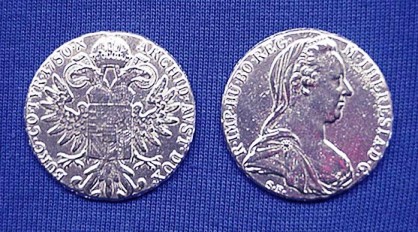
The answer to the current Euro crisis is quite simple.  It is to reinstate the Maria Theresa Thaler (see Wikipedia) as the basic currency of Europe, benchmarking a variety of other currencies against it.

Furthermore, fiat currency issue (paper money) should be one hundred per cent backed by reserves of the MTT and credit creation by banks and others limited to four times only of their holdings of the hard currency MTT reserve.

How could this policy be put across to the general public?  It could be called “Back To Basics”. 

There would need to be an appropriate regulatory regime in place in each country with an adequate criminal law to guard against counterfeiting, fraud and financial malpractice.

If we were to use the experiences of the past in these matters it might be difficult to know where to transport convicts to but I am sure somewhere could be found.

It might seem to be an outlandish suggestion but it could be better than the alternatives we face.


Friday, 18 May 2012

Go Back To Start


Given the course of events, it is clear that what is happening in the Eurozone and other parts connected or adjacent to it is very like when my home computer begins glitching and twitching.

Whilst it might need a new operating system, world government or anarchy or tribal reversion or back to hunter gatherings perhaps we should see if the problems arise from any current programme in use.

We could try re-installing the Europe programme to begin again as above but the next time round do a better job on the settings and temporary governing files.

We may finish up with something like this in any case.  Looking at the most western areas if the current occupants of Ireland do all emigrate then the Scoti could return there allowing a welcome return of the Picts.

If we get automatic shut down when it does reboot then it might be similar, who knows?

The way things are going anything might be worth trying.


Thursday, 17 May 2012

Back To The Past And Future


Last night, Wednesday, we went cinema world wide in full HD, well not quite.  It was a six camera live screening of a performance and we were behind and alongside cameras and very likely nowhere to be seen.  This would have been a great relief to those who paid up front to see something colourful and interesting.

Which they did, it was of a very high standard and because I was able to detect what was going out live from the back of a camera ahead of me, all those out there across the globe will have had their money’s worth and got what they paid for.

Thinking about the other screened live or recorded programmes or events we have attended down the years and contrasting with the present is intriguing.  There have been quite a number, but the question was how many are still in the archives and what about all the events that were not filmed?

From time to time on TV there are programmes dealing with the past that rely on archive footage of amateur film making.  It is clear that, although very expensive, it was possible at an early stage to film in colour and also in black on white.  The problem was sound recording for the most part.

But this was not impossible to achieve.  By the 1960’s technical advances had made it all much easier and far less costly for ordinary people, let alone others with funds.  But a great many of leading events are often only recorded by accident, in heavily cut news reels or by people with no official standing.

Yet in the Arts generally, never mind other sport and activities, there was a general reluctance to resort to film productions or events.  When I think about all the plays, music, dance and other major events that might have been put on film, there has been a huge loss of both history and record in these fields.

There are some archives, notably the BBC one, but this is an intractable one to find anything and involves penal charging.  The BBC often seems almost resolute not to have its lovely archive material exposed to the view of common people.

The result is that in documentaries or the study of something there are only scraps at memories, fading partial memories and written only information.  Yet the chance was there to record, store, maintain and renew it from one time to another.

Perhaps there were some people arguing that something should be done to create, maintain and enable an archive or archives on film but it may be not.  Why did it not occur to some group of far sighted people that this could and should be done?  It would not have been too difficult or too costly at least to do a basic film of record so that a particular production or event could be remembered as it was.

One can understand all the querulous carping about copyright, who was to do what and why it was to be done and who would be responsible.  But the technology was and could have been made available. 

It is not just that we have lost a way of understanding and appreciating the past, in a way we have lost a part of what we are and will be.


Tuesday, 15 May 2012

Losing The Picture


Looking around the media, the web and the rest it is quite clear that whilst there are a lot of able, highly intelligent, well informed and well connected people the pace of events and the complexity means that nobody can claim to have a full understanding of what is happening financially and politically.

By definition the politicians who are supposed to be making key decisions now work on a lot less information, data and analysis and need to be advised by people who do know more and have the ability to understand more fully.

The difficulty then is that if what the people who voted in or critically support those politicians do not like the advice and the implications then almost inevitably there is a desire to delay, attempt compromise where none is to be had or to evade making decisions at all.

Worse, is that if the channels to those politicians are controlled or policed by people with particular interests to serve then the distortions could be serious and damaging in the process of determining policy.  We have been here a few times in history, think of your own examples.

At present around the world it seems that all of them have not simply “lost the picture” they do not know what they are looking at.  They want the picture to be a Renoir when at best it is a Jackson Pollock.  Not only that but it is one which Pollock created intuitively or according to whim.

Even then that picture is replaced by another one apparently quite different perhaps shifting more towards one fractal shape before morphing suddenly into another.  In short not just the politicians, or their advisers, but all the experts and commentators are behind the game.

Those who may be closer to any understanding in the present world crisis seem to be now reaching the point where they feel no understanding is to be had because by the time you have got the message out and circulated it has all moved on and fast.

But the public and people as a whole want simple answers and clear policies and most some sort of security and protection from economic storms and dangers.  Inevitably, the come to feel they are being lied to or the victims of conspiracies by “the other”.

This is how in the past dictatorships and authoritarian governments have arisen in states and polities where serious upheavals have occurred.  It seems to be happening around the world one way or another, including the UK and the USA.

So will Western Civilisation as we know it today begin its end in Greece which is where is it supposed to have begun? 

There was a twitch on the North Anatolian Fault Line yesterday; perhaps the ancient gods are awakening.


Monday, 14 May 2012

Peering Into The Future


A mail plopped into the inbox about three of weeks ago.  It was an invitation to a reception at the House of Lords.  Preening myself I was about to compose an elegant reply of acceptance grateful at last that I had been recognised when native caution made me scroll down to the fine print.

There was a charge, no less than £55 a head.  As I need company in my travels that meant two.  Adding on rail fares, car parking and incidentals the figures were rising over £150 for the occasion.

There was also mention of those who the invitation had been directed to and this was not encouraging.  Essentially, it would be a pack of “has beens” meeting up with a few ennobled “yesterdays persons” for what appeared to be a last and spurious gasp of networking.

The chances on that if lucky there would be two or three more or less five minutes gabbing about current obsessions in which to deliver my message that forcing the nation back to a 1940’s diet of cabbage, potatoes and denial of personal transport would end the obesity crisis might have a hearing by persons of influence.

The rest of the session probably would mean trying to join a huddle of other “has beens” in which some sentient life might be found to exchange anecdotes that had become honed for delivery over many years.

The refreshments on offer were all too likely to be second rate nibbles, third rate wine, or if driving inorganic orange juice.  We would then stagger out into the night hoping only that by dropping the line “We were at the House of Lords talking to Lord Bunfight, you know he was…..” we might impress either neighbours or tradesmen.

Her Majesty was at the House of Lords last week promising to reform them again.  When this appears in the draft of her speech she must wonder if the Cabinet computer “paste” function in the word processor has become stuck because here it is again.

As many have observed at the moment there are better things to be spending our government’s and Parliament’s time on.  There is a great deal to do.  Especially, as in the proposals for reform it is far from clear what the House of Lords is supposed to be doing or why. 

It is usual in a nation’s constitution pay some attention to this kind of thing but that is not the way we do things in the UK any more.  But in many ways it is all a little sad when we look at history and the grandeur and state of the past.

The House of Lords began when the military equestrian elite were nobility, almost all of them descended from, related to or closely connected to the King.  Down the years it began to accommodate the wealthy land owners and a few others adding the bishops and top lawyers.

Through the 18th and 19th Centuries, inflation set in as political parties contended for control of this body that could veto most legislation proposed by the Commons, until more radical changes occurred during the 29th Century.

Now there is this numerically bloated body of place persons, hanger’s on, government appointees of expediency and redundant ministers swanning around looking for things to do.

One of them is being wheeled out to talk to hapless members of the public about this or that who are obliged to pay for the privilege and who can be “conned” into coming.  At least they come a lot cheaper than the current cost of contact facilities for members of the government and opposition front bench.

However, the market may be drying up, because a couple a days ago a mail arrived to tell me tickets are still available, perhaps if I hang on there may be a two for one offer.

If this is the British Constitution today then it is all very sad.


Friday, 11 May 2012

See You Later Demonstrator


Two days after having posted on Brooksley Born and her stance on over the counter trading, notably in derivatives, JP Morgan have lost £2 billion on one of its trading desks, just like that.  As the boss of the man concerned earned £14 million last year, perhaps he was underpaid and need to moonlight at the expense of the day job.

Rather longer ago, March 2011, I was wondering if Cameron might not be headed for the modern equivalent of the Marconi Scandal of 1912 because of his cavalier approach to contacts and money movement. 

In this case it wasn’t the issue I had in mind, the Serious Fraud Office botched it, but it has emerged that he was much too close to people he needed to stay way clear of and whose capacity for causing embarrassment and disaster is unlimited.

Meanwhile, over the Channel, it appears that the new very egalitarian and deeply socialist President has useful property investments in Cannes.  All we need now is the accounts in Zug or Zurich into which the rents are paid.

His promises of heavy taxes on the rich have sparked great interest in those selling London property, in that a flood of French rich people is said to be heading for the border.  They will not be held in a modern version of Sangatte, however, it will be somewhere with better shops and wine merchants.

This supposes that these people have not already made arrangements to protect their wealth and incomes.  My information is that for many years the French elite have almost all taken the steps necessary to shield their wealth and have been fully protected by the privacy laws they enjoy.

The only reason they may be in London is to snap up property available at present prices knowing that we and France could be heading for rampant inflation soon from all the money being slushed into our financial systems to reduce the real liabilities of governments and their immediate allies.

Amongst them are institutions such as the Santander Bank.  It claims that the problems in Spain will not affect the British end because that is run by a separate company.  Does that means that there is no risk from systemic issues or just that the UK taxpayer will bail them out regardless?

The flood of news and figures is becoming more and more difficult to make sense of.  We have governments that cannot govern, civil services that lose money at a catastrophic rate, banks incapable of banking and educated workforces unable to find work that requires any sort of extended education.

One is almost driven to go out and demonstrate about something.  The difficulty is finding something which makes much sense to demonstrate about.


Thursday, 10 May 2012

Sick As A Parrot


The sorrowful bird above is a recent birth to a well known family of Leipzig parrots.  Apparently, it has been rejected by its mother but has been taken to heart by the locals and with wider coverage.

A while ago there was an isolated polar bear cub called Knut who faced a similar predicament.  The trouble began when the cub got bigger and rather less cuddly.  The problem with the parrot is what economic doctrine the European Central Bank (the ECB) might teach him.

There has been a good deal of attention given to elections in Greece, France other places and the UK local elections.  Occasionally, the US Presidential Election intrudes on our screens, if only when the usual issues arise.

Almost nothing has been said about the elections in Germany.  These in the regions, or Bundeslander, the partly sovereign constituent states of the Federal Republic matter a deal and are pointers to the future and any potential policy changes there.

Shortly, the big one is about to go the polls, Nordrhein Westfalen, although opinion has it that whatever the changes in the balance of the parties, actual things may not change much given the imperatives governing German policy at the present.

These are that Germany is frantically trying to prop up the Euro system via the ECB.  This is not simply out of sincere belief in the EU but because some of its major banks could be in deep trouble if things go any more haywire.

In addition to the Big Banks and what happens in Frankfurt, the financial centre, there are a great many smaller banks, notably the Landesbanks that have not been as wise and careful as we expect German institutions to be.  Some of these are not in good shape and giving cause for concern.

The political issues at present in Germany mirror those in other countries in many parts and we will have to see what emerges.  But Germany is not the centralised state with an all powerful governing city. 

Thanks to British wisdom and guidance along with American beliefs in State Rights in 1955 the Federal Republic was founded as a decentralised entity with powerful regional and city authorities reflecting the history and traditions of Germany.  I was there.

However, the upshot is that ancient history can intrude on the present.  What we seem to have is a revival of The Schleswig Holstein question, see the many Wikipedia items on this.  This is because old minorities seem to be back in business:


In the mid 19th Century, notably in the 1860’s in the run up to the creation of the German Empire in 1871 this question was at the heart of the struggle.  It was very difficult as well as being very old.

Lord Palmerston, the British political leader and sometime Prime Minister once said:

“The Schleswig-Holstein question is so complicated only three men in Europe have ever understood it. One was Prince Albert, who is dead. The second was a German professor who became mad. I am the third and I have forgotten all about it.”

We have become so accustomed in the last 150 years to regard Germany as one nation, although divided between 1945 and 1990, we forget that for centuries it was a complex collection of more than 300 states of different kinds.

Perhaps the eagle of Brandenburg is about to be replaced by a sick parrot.