Friday, 14 January 2011

Planning The Past


Watching TV is becoming ridiculous. On some channels the advertising bits are now up to a third of the programme timing. The cunning lies in starting with little interruption, then setting up the story so they hit you with three long ones in an hour that with the padding before and after mop up all that time.

Yes, if you have a “box” you can avoid this. But sitting there clutching a remote and needing supreme skill and judgement to zip over them does not add to the joy of watching or the entertainment. Luckily there are one or two channels where the problem is far less, but these are specialist in many ways.

Indeed, there is the BBC but this is now spending more and more time “puffing” its own and adding endless crash bang wallop intro’s and crossovers to give bad news to the ears or what is left of them. The difference in decibel levels is marked.

Often because of all the background and sounds off on the screen (natural like they say) you have the sound up more than wanted to hear the speech. This is often not good, over the shoulder, going away etc. Then you have the sudden and unexpected lurches into heavy sound, taking it into the danger levels for many people.

Also, there are the endless repeats and series with similar names so you never quite know where you are or whether you have watching them. Little wonder we are often reverting to radio, CD’s or DVD’s. As for the football………

Sometimes it is interesting to put on a football match and have on sound only a music channel. It can be quite a party game to guess which team goes with which piece of music. Does Liverpool FC at present go with Meatloaf’s “Bat Out Of Hell”?

One of the more off the wall programmes is “Heir Hunters”. Perhaps it should be called “Schadenfreude” because it deals with unclaimed estates and the people who earn their keep by searching for heirs and taking commissions to convince The Treasury that there are beneficiaries according to Probate Law.

The latest series tells us that in this property owning age around two thirds of us who go to the great property ladder in the sky fail to make wills or dispose of our wealth to those who we feel should have it. I can watch it safe in knowing that amongst my eligible cousins there is not a cat in hell’s chance of a brass farthing.

This can have some unexpected results. Often the money will go to people that they have never known or knew existed. Sometimes, it goes to a member of the family they detested. All too often the one who most deserves something does not get a penny or is short changed by the rules.

What the programme does tell us that there is no shortage of disrupted or tragic lives in the immediate past. When the researchers are driven back into the 19th Century and the Census Returns etc. it is no better.

If the figure of two thirds is given, this is more that that alleged in the first series which might suggest a worsening of the overall situation in the latest generations. There are now the complications of how Probate Law interacts with modern living patterns.

Also, as many people have now taken property abroad they run into Probate laws that are very different and filled with additional complications. All too often they have blithely ignored the potential effects of this.

How long, I wonder, before the State decides that people cannot be trusted to make proper decisions on the disposal of their wealth and takes the lot?

Thursday, 13 January 2011

Malaysia, Losing The Rubber


On the Noriel Roubini web site, the Wednesday Note (12 January 2011) is a piece about the changes occurring in the Far East.

One way and another there is something familiar about what has happened in Malaysia and the potential consequences.

In addition you might wonder what this means for much of our own manufacturing sector and that of Europe.

Quote:

Malaysia’s policy makers have been forced to confront the factors blocking the country’s rise to high-income status. Facing higher labor costs, the economy has been unable to maintain a growth model based on low-value-added manufacturing that was largely successful for the 30 years prior to the 1997 Asian financial crisis.

One of the most noticeable manifestations of this so-called middle-income trap has been the secular decline of Malaysia’s once-dominant electronics and electrical products (E&E) sector, examined in “Still Not a Tiger: The Decline of Malaysia’s Electronics Sector,” available exclusively to clients.

At the sector’s height in 2000, E&E accounted for more than one-third of the country’s total value added in manufacturing, over 70% of revenue from manufacturing exports and almost 4% of world E&E exports.

Since then, Malaysia’s E&E sector has witnessed dramatic deceleration in productivity, stagnation in exports and deterioration in its global market share.

The sector remains dominated by downstream industries that increasingly face competition from lower-cost producers in the region, including the Philippines and China.

Confronting similar challenges, the Asian Tigers (South Korea, Taiwan, Hong Kong and Singapore) were largely successful in transitioning to higher-value-added E&E production.

Beginning in the 1960s, Malaysia and Singapore (and, to a lesser extent, Taiwan and South Korea) industrialized by encouraging multinational corporations to take advantage of their relatively cheap labor forces and establish downstream E&E production facilities.

In Singapore in particular, the presence of multinationals spurred local entrepreneurs to begin “clustering” around downstream enterprises, acting as suppliers and logistics managers.

Over time, this led to the development of a robust, indigenous E&E sector that increasingly produced further upstream, which typically included the stages in the supply chain in which labor adds more value—i.e., the stages with higher levels of labor productivity.

By the time labor cost increases forced downstream production facilities to lower-cost markets, local firms were experienced and competitive enough to continue operating in the E&E supply chain at higher levels of value added. In this way, Singapore has managed to increase its global market share of E&E since 2000.

In contrast, Malaysia’s E&E sector has been unable to adjust to shifts in the country’s comparative advantage. One important barrier has been ethnicity-based affirmative action policies, which have stifled the evolutionary process that other export-driven economies in the region were able to ride to higher-value-added production on their way to high-income status.

Established under the New Economic Policy of 1971, affirmative action in Malaysia seeks to rectify socioeconomic disparities within the local population by expanding opportunities for ethnic Malays (bumiputra or bumiputera) in areas like education, housing and investment, often at the expense of other ethnic groups (namely ethnic Chinese).

These policies have not only exacerbated the country’s brain drain of talented non-bumiputra; they also have created a strategic disadvantage for local firms by limiting both human and financial capital and perpetuating an unlevel playing field for entrepreneurs.

All domestic companies incorporated in Malaysia must reserve at least 30% of new shares for bumiputra to purchase at discounted prices. This essentially taxes local start-ups that wish to go public and makes expansion more difficult, which helps explain why initial public offering growth was relatively flat through the 2000s and why equity remains a minor source of manufacturing investment financing.

Meanwhile, the continued presence of the government in the economy—via procurement policies and access to joint ventures with the nearly 500 government-linked corporations—has provided ample opportunity for rent-seeking by well-connected bumiputra who can take advantage of favorable policies.

The New Economic Model—presented in 2010 as a 10-year vision for Malaysia’s ascension to high-income status—proposes “revamping” affirmative action “to remove the rent seeking and market distorting features” and shifting the basis for eligibility to socioeconomic status, rather than ethnicity.

Yet given the governing party’s reliance on bumiputra support, major changes are unlikely until new elections are held and the government has the political confidence to confront popular resistance to reform.

The underperformance of the E&E sector over the past 10 years should serve as a warning to the country’s policy makers that the continuation of distortionary policies may limit Malaysia’s future growth prospects.

Unquote

The heritage of Empire?

Wednesday, 12 January 2011

The People Spoke


Two months after the Coalition took office a graffiti slogan appeared by the railway line going into London.

It proclaimed “Sack Cameron”.

It is a little while since our last visit, but yesterday we travelled up again.

The slogan had been amended to read “Back Cameron”.

Indeed, the Conservatives will stop at nothing.

Monday, 10 January 2011

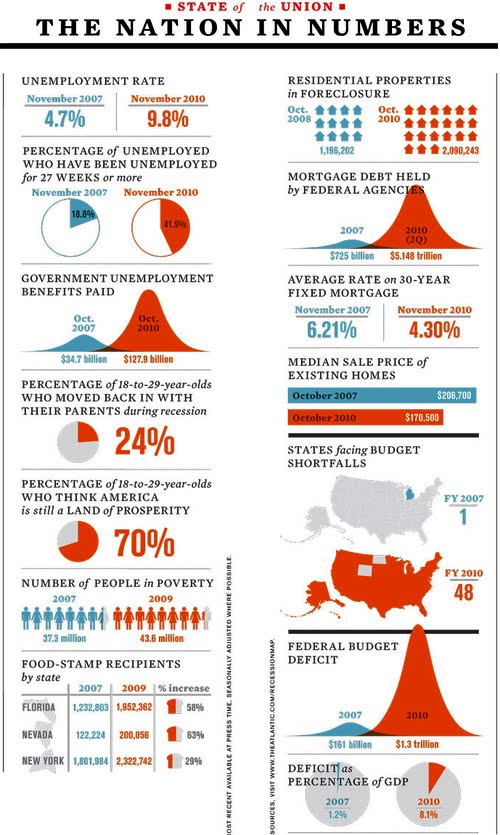
Change In The USA, Taxation And Representation


Above is a snip from Financial Armageddon that was taken from a fuller article below in The Atlantic dot com. If you look at it, a short one, and click on the picture you will get the full picture.

http://www.theatlantic.com/magazine/archive/2011/01/how-the-recession-changed-us/8347

The USA has changed in the last four years. How far is the change either permanent or just a stage in a long term decline?

In the UK we have paid relatively little attention to the USA recently because our media has interesting celebrities to discuss. A tragic event has now caught our attention, but with little interest in the overall background.

For a long time the USA has been one of the key motors of the world economy. A radical change there will affect us all, for better or worse.

Elsewhere we see that there the “growth” has been almost exclusively amongst the very rich while the poorer half of the population is in deep trouble as are most of the States of the Union.

How will that affect the UK and Ireland, will it be worse here or better?

Saturday, 8 January 2011

2011, A Bad Beginning


If you really want to know just how crazy the world of international finance is, how far out of control it has gone in recent years and why so many ordinary people living ordinary lives have had so much misery and loss inflicted on them you have only to look around you.

Or read the major feature in the Financial Times of Friday 8 January 2011 relating to the serious situation at Consensus Business Group, its major subsidiary Peverel and the implications for their eventual owners, well known property investors. It seems that Peverel will have to be sold by Consensus because they are in the hole for £100 million.

The Bank of America is riding to the rescue with the usual armoury of debt-equity swaps and other complicated arrangements. For those of us who follow USA affairs this may not be good news, there seem to be a number of reservations about that organisation at the moment. American taxpayers, already in a property crisis of their own, may not be amused.

In your home district or not far away there will be a block or blocks of flats, built for and occupied by elderly leaseholders who needed or wanted to make life simpler and easier in their declining years. Most of them were put up by McCarthy and Stone. Initially they ran their own in house property management services, Peverel, to do the basic work.

This was essentially site and buildings maintenance, attending to repairs and the usual services and keeping a degree of ordered, low key control over how the communal and related facilities were managed. Necessarily, this included keeping good relationships with the residents and occasionally dealing with crises.

There were not medical or social services functions or anything elaborate, it was all bog standard site and building functions with a top dressing of polite and ordinary human contacts, albeit being with some people who were ill and vulnerable. One objective was to ensure a quiet life as far as possible for all.

During the first decade Peverel was sold and bought several times before ending up with a very acquisitive and active financial group, Consensus BG, aiming to build a major, if not controlling, stake in property management and control.

This group had a number of aims. One was to engage in highly leveraged borrowing and lending to enable further acquisitions. Another was to securitise its assets and income streams to assist this. Another was to work the assets very hard to fund the personal Trusts, celebrity lifestyles and add to the fortunes of its owners.

Accordingly, in the leasehold retirement flats the service charges have increased well above the rate of inflation, other charges have gone up sharply and there is a raft of other fees and means of extracting money. The properties are a cash flow with little or no controls of means or ends.

In the warp and weft of all the financial dealings between the associated and owned companies, the relevant trusts, the inter lending, charging, income flows, fees and the rest it is impossible to disentangle what has been going on.

As there major outflows to accounts etc. in tax havens it is also impossible to find out what has happened, how much is involved, and who owns what because of secrecy.

Given the numbers and skills of all the lawyers involved everything will be legal in one jurisdiction or another. If there have been doubts in the minds of some of the good and the great these will have been assuaged by sessions on the ocean going yachts, introductions to the celebrities of the day, contributions to party funds and assistance to those interests and charities dear to the hearts of our elites.

The media have been entranced by these operations and any number of praises have been sung and applauding been done by journalists and financial reporters over the last few years. For those who actually live in the properties, however, there is now an organisation devoted to fighting exploitation and mismanagement. There are also a number of legal wrangles arising.

Many of the pensioners involved have been affected already by inflation in key areas, not included in the usual indexes. A good many who do have private pensions are in real difficulty. Those who depend on savings, and there are many widows, have been badly hit over the last couple of years.

So in the space of a decade a reliable and adequate means of homing and catering for the elderly to allow them a degree of peace and a settled way of living has turned into an arena for excessive and damaging financial risk taking. They are being stripped of their savings, face a management concerned only with money targets, and are embroiled in unpleasant disputes and legal wrangles.

If you want to realise the nadir of it think of this. It is 2.00 a.m. on a cold January night. Police and ambulances are gathered outside a block on a major emergency. A resident is in real medical danger.

But they can’t get in, the company in house security service will not let them in because it has been reorganised to improve its financial performance and bungled the systems.

Someone woken by the racket lets them in and assists them to the emergency. A few days later the company tells its manager to tell the someone that they will face action because an additional very minor cost has been incurred that was not authorised. Its security firm had to spend time looking it its files.

Now those in the block and others like them will learn that they are in the hole for their share of the company’s problems and the one certain thing is that they will paying and not those who were responsible. The money men will not be the real losers, one of them, in real trouble, is presently funded by a state owned bank.

Nothing will be done because one of the owners, according to reports, has bought personal access to the Prime Minister under his party’s current lobbying arrangements.

Wednesday, 5 January 2011

Gather Ye Taxes While Ye May


In all the debate and argument about what the problems are and what is to be done it is clear that much of the media and many of the politicians simply have not realised the degree of change that has occurred since the 1980’s. Nor has the increase in the pace of change over the last decade impacted on their thinking.

Consequently, they are carrying round in their heads a baggage of beliefs, ideas, and assumptions that derive from not just the late 20th Century but from a longer past. This does not only apply to economics and politics, it has happened across many fields of study.

So when they are faced with practical problems of key importance now and for the immediate future the debate is couched in arguments and policy platforms that are increasingly disengaged from what is actually out there.

One feature of the debate on taxation is the lack of understanding of the realities. We have a government claiming to be attacking tax evasion and criminality yet depending for its work and key support on people who pay comparatively little tax.

But this is tax avoidance which is applauded by many as a worthwhile feature of the economy to advance growth etc.

Cutting through the complications it is my view that we now have an economy part of which is The Taxable Economy and the rest which is The Alternative Economy.

The situation is that The Taxable Economy is not large enough to fund the government’s needs for revenue and to some degree real lending. Nor in present conditions can it be made large enough in the foreseeable future to cover the spending and associated plans. Also, year on year it is declining in real terms.

The Alternative Economy has three parts. One is the legal activities by which tax is less than it might be for those who might pay. This is broader than people assume given the many and varied nature of the tax breaks handed out to all sorts of people and activities. This includes tax avoidance as we know it.

The second is the range of activities that escape tax. This covers activities such as Barter, DIY, helping out the family or the neighbours, voluntary work, “community” work etc. This is normal and unrecorded activity that has always been part of life. In the past for many, especially in the poorer sections of the population, this was a real and vital part of their personal economy.

The third is the illegal sector. Tax evasion, bootlegging, knock-offs, petty thieving (M.P.’s expenses come to mind), pilfering, drugs, trafficking of one kind or another and money laundering and all the full range activity outside the law to yield income and profit with little or no tax being paid.

If my wife cuts my hair without charge, this is Alternative 2. If I claim hair cutting on my expenses, this changes it to Alternative 3. If we set up a charity to cut the hair of the poor at low cost and this allows tax breaks then we are functioning in Alternative 1.

If we set up a company registered in Jersey, cut hair as a job and then ensure that the revenues go there and avoid tax again this is Alternative 1. If you think that this is unlikely then we have a jobbing builder along the street who does just that.

To make matters worse for the imbalance between realisable tax revenue and obligations in the spending commitments of government there is a range of payments that worsen the situation.

One is the discouragement of employment by over regulation and haphazard rules and another is all the obligations to give money to people from whom little or no tax can be realised other than on their spending.

In short the government’s own spending in many areas exacerbates the problem on top of all the tax breaks that have been handed round to win friends and votes.

So the government now has to increase the burden severely on those who have to operate within The Taxable Economy, now largely middling and lower income people. It might be tempting to tax property, but as the USA is finding out, having such a tax is great when the values are rising, but a disaster when they crash.

Taxing the rich will catch comparatively few because many are already in The Alternative Economy and so much of UK economic activity is run by people in other countries. Moreover, as many countries are engaged in a race to the bottom in taxation it will be hard to accomplish.

My fear is that there is no way out of the maze and worse still neither the media nor the politicians have the faintest idea of what has happened under their noses.

Monday, 3 January 2011

Isn't This Where We Came In?


What can be said at the beginning of this year? Many people make predictions. I can confidently say that as there are so many varying, contradictory, confused, vague, expert and inexpert that some could be right.

Which of them will be I do not know. What I can say is many people will say and do things they will later regret, things will happen that are unexpected, some of the expected or hoped for things will not happen and the human race will be no more wiser or reliable at the end of the year than at the beginning.

On the subject of wisdom Grant Shapps, Minister for Housing, who has been in and out of the property market along with others seems to be saying that he is alright the rest of us can forget it in terms of Brown’s Boom, the end that was never to be it seems is imminent.

Quite how he can square this with reports of funny money flooding into London to keep the pot boiling, encouraged by the government, is uncertain.

When I walk along the High Street in my town most of the shops that used to sell things are now either employment agencies or estate agencies.

There is a discrepancy between them, because the salary levels, many for jobs with responsibility requiring experience and qualifications, would not allow the takers to get into the job market on the basis either of salary or possible savings.

A reason for this is that lenders have recently rediscovered the knowledge that if you lend pots of money to people that cannot afford to repay it on the basis of them telling you what you want to know about their incomes and personal status, you may find yourself stuck with either bad debts or unsaleable overpriced property or both.

So what would Grant Shapps like to have? It is more lending to people on a relaxed basis and with lots of “innovative” mortgage products subject to little or no regulation. This is just what was involved in the recent crash.

One worry for the government is the needs of families. These are said to be in decline because of social changes. But according to an item in the Hals Report there could be other reasons.

http://www.thehalsreport.com/2011/01/is-something-wrong-with-the-sexual-development-of-human-males/

We are told to be a high consumption society. Much of what we consume and eat is now dependent on petro chemical products. It is the derivatives of these shoved into almost everything we eat and use that is doing the damage. It is not just us, it is also the other creatures of the earth.

“Not with a bang but a whimper” as the poet T.S. Eliot said in his poem “The Hollow Men”

But there could be a good big bang on the way that will end the debate on the Euro because it will end much of Europe.

Apparently there is a huge Caldera in Italy compared with which Pompeii is but a pimple. British scientists are arguing with others about the right to drill holes in it.

Is this is good idea , I ask?

http://www.armageddononline.org/Campi-Flegrei-super-volcano-caldera.html

I can predict that in 2011 there will be some volcanic activity somewhere. How big and where and with what effect I do not know. We were told about the risk of a larger secondary Icelandic one that has yet to happen and other possibilities. Your guess is as good as mine and maybe better.

This year, next year, sometime when?